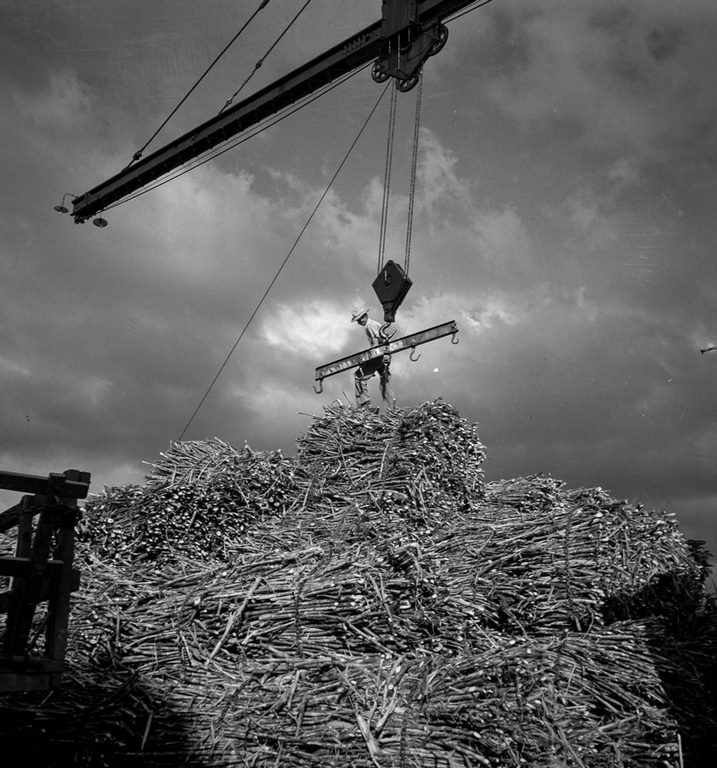
High above a towering mound of cut cane, a crane boom stretches into a heavy sky while a lone worker balances near the top, guiding the rigging with practiced care. The scene at the San Sebastian depot feels equal parts choreography and risk: steel cables taut, hooks dangling, and a dense, tangled surface of stalks that looks as sharp as it is unstable. Even without seeing faces clearly, the posture and placement tell a story of strength, routine, and the constant attention demanded by industrial handling.
The sugarcane itself dominates the frame, stacked into an uneven hill that hints at the scale of the harvest and the relentless pace of delivery. Each bundle suggests field labor already completed elsewhere, now converging at a transfer point where agriculture meets machinery. In that meeting, the depot becomes more than a backdrop—it’s a working hinge in the supply chain, linking growers and transport to the mills and markets beyond.
For readers searching the history of sugarcane in San Sebastian, this photograph offers a vivid glimpse into everyday logistics rather than ceremony or spectacle. The stark contrast between organic stalks and mechanical lifting gear underscores how modernization reshaped rural economies, turning seasonal cutting into a system of schedules, loads, and coordinated crews. It’s an evocative “Places & People” moment: one worker, one lift, and an entire industry implied in the shadows and sky.