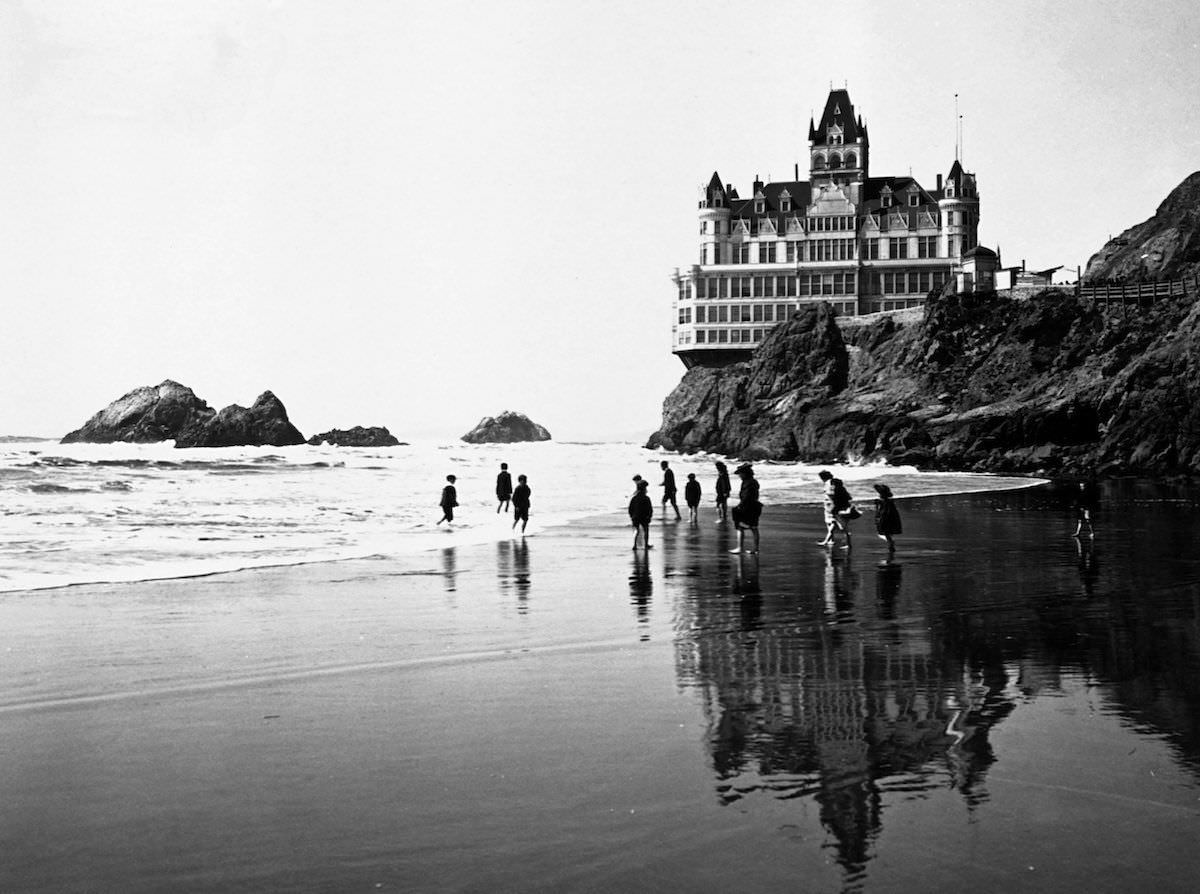
Against a wide, bright sky, Cliff House rises like a grand silhouette on its rocky perch while small groups of beach walkers scatter across the wet sand below. The incoming surf breaks in soft bands, and offshore rocks punctuate the horizon, giving the scene a dramatic shoreline profile. Reflections stretch beneath the figures’ feet, turning an everyday stroll into a striking play of light, water, and architecture.
Early-1900s seaside leisure comes through in the details: people wading at the edge of the tide, others pausing as if to watch the waves, and a few moving in pairs or clusters along the darker, mirror-like beach. The contrast between the towering building and the modest scale of the walkers emphasizes how destinations like Cliff House drew visitors for fresh air, spectacle, and a sense of modern outing culture. Even without close-up faces, the image feels crowded with human presence—tiny, transient silhouettes set against a permanent-looking landmark.
For anyone searching local history or vintage coastal photography, “Beach walkers near Cliff House, 1902” offers a vivid slice of places and people meeting at the waterline. The composition balances natural forces—surf, rock, and shifting sand—with the manmade drama of a cliffside structure that commands the view. It’s a reminder that the shoreline has long been a public stage, where ordinary moments become memorable simply by happening in an iconic setting.