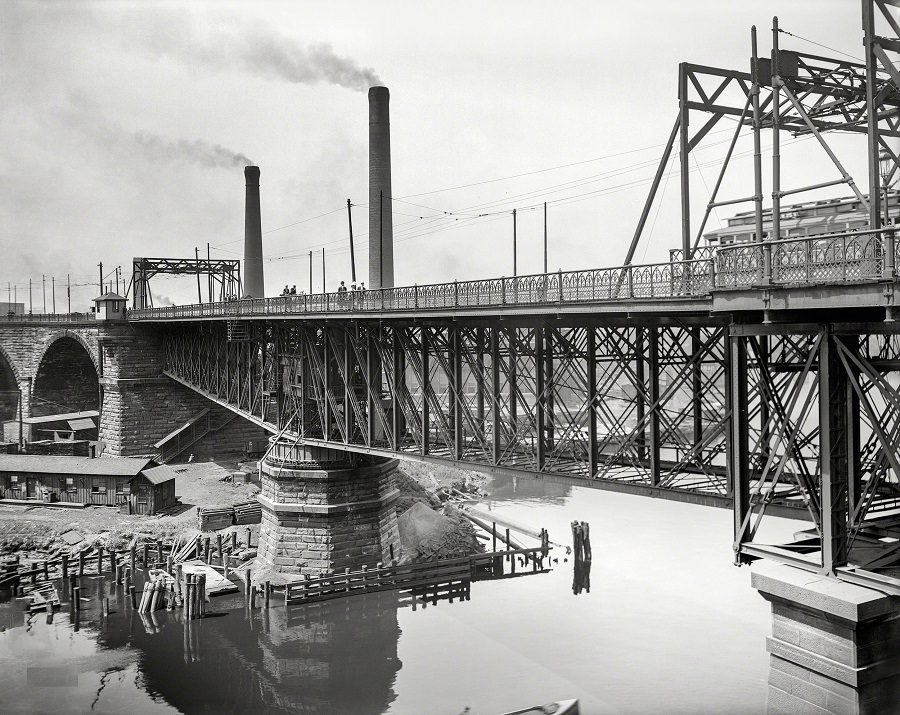
Steel latticework stretches across the Cuyahoga River as the Superior Avenue viaduct binds Cleveland’s river valley to the city beyond, a working span built for movement and momentum. Decorative railings trace the deck while overhead wires hint at the era’s electric streetcars, and the stone abutments and pier anchor the structure with a sense of permanence. Below, the calm water mirrors the geometry of trusses and masonry, turning an industrial crossing into a surprisingly composed river scene.
Along the banks, the riverfront reads like a busy workshop: pilings, rough timbers, and small utility buildings cluster near the shoreline, suggesting ongoing construction, maintenance, or the everyday labor that kept the waterfront running. In the distance, tall smokestacks release a hazy plume, a reminder of the factories and powerhouses that shaped early 20th-century Cleveland. The contrast between heavy infrastructure and open sky underscores how the city’s growth depended on both engineering confidence and constant industrial output.
Viewed today, this circa-1910 photograph offers more than a bridge portrait—it’s a snapshot of urban connectivity in the making, where Superior Avenue and the Cuyahoga River meet at a pivotal corridor. The scene invites closer looking at period details: the pattern of the ironwork, the spacing of poles and lines, and the river’s edge shaped by human hands. For anyone searching historic Cleveland images, Cuyahoga River bridges, or early streetcar-era infrastructure, the viaduct stands as an emblem of a city learning to span its own divides.