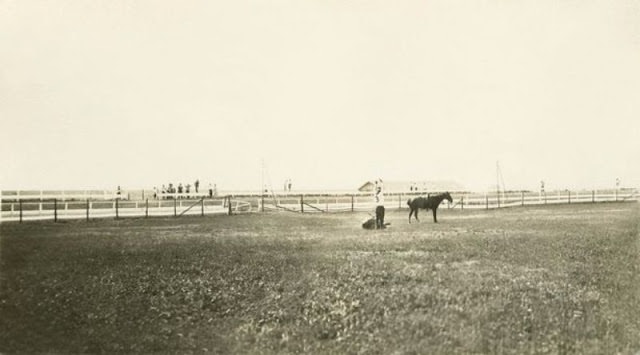
Out on a broad, open arena ringed by simple fencing, William Hale takes his place in a roping contest that reads like a snapshot of working cowboy culture. A horse stands ready nearby while a small figure in the foreground anchors the scene, emphasizing the distance and scale of the grounds. In the far background, spectators gather in a line, their silhouettes hinting at the anticipation that always hangs over timed events and skilled handling.
Roping contests were more than entertainment; they grew from practical ranch work where control, speed, and precision mattered. The arrangement here—horse, open space, and onlookers positioned along the rails—suggests a community event where technique could earn both pride and reputation. Even without close-up details, the photo conveys the rhythm of competition: the quiet moments before the throw, the watchful crowd, and the wide field that leaves nowhere to hide a mistake.
As a piece of Western history, this image helps place William Hale within the lived experience behind the cowboy legend. The sparse structures on the horizon and the expansive, grassy foreground evoke the rural settings where such contests flourished, blending local gathering with demonstrations of real-life skill. For readers interested in historic roping, early rodeo traditions, and the people who practiced them, this photograph offers a grounded, human view of the sport in its everyday environment.