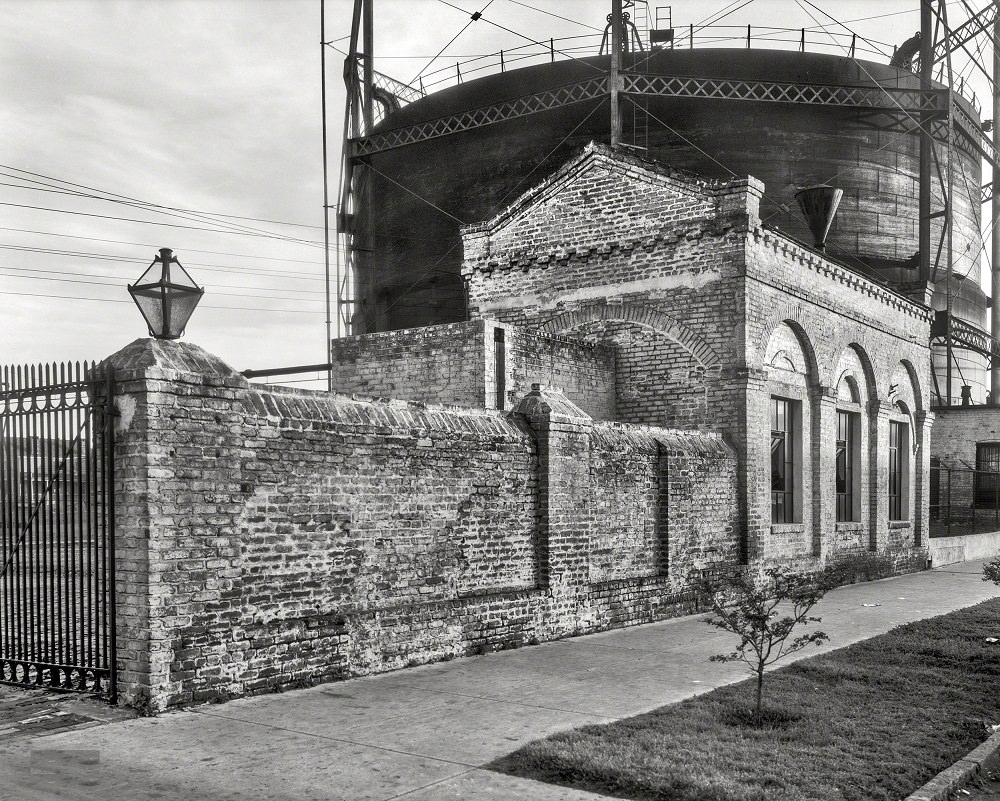
Brickwork dominates the foreground at the Charlotte Street Gas Works in Charleston, South Carolina, with a stout perimeter wall and iron fencing that feel as much like a boundary as a statement of permanence. Beyond it rises the immense curved form of a gas holder, its ribbed metal skin and latticework frame towering over the low street-facing structures. Even without people in view, the scene suggests a busy industrial site built to serve a growing city’s everyday needs.
Along the sidewalk, the modest building’s arched windows and layered masonry details show how utility architecture often borrowed from older design traditions, blending the practical with the familiar. Overhead lines crisscross the sky, emphasizing the infrastructure that connected neighborhoods to fuel, light, and heat in the early twentieth century. The careful composition highlights contrasts—soft lawn and sapling against hard brick, quiet street edge against the hulking machinery behind.
Set in 1937, this Charleston gas works photograph offers a vivid glimpse into the systems that powered urban life before modern energy networks became invisible to most residents. Industrial history enthusiasts will recognize the signature silhouette of the gas storage tank, a landmark form in many American cities of the era. For anyone exploring Charleston’s past, Charlotte Street serves here as a reminder that the city’s story was shaped not only by grand homes and steeples, but also by the working infrastructure that kept its lights burning.