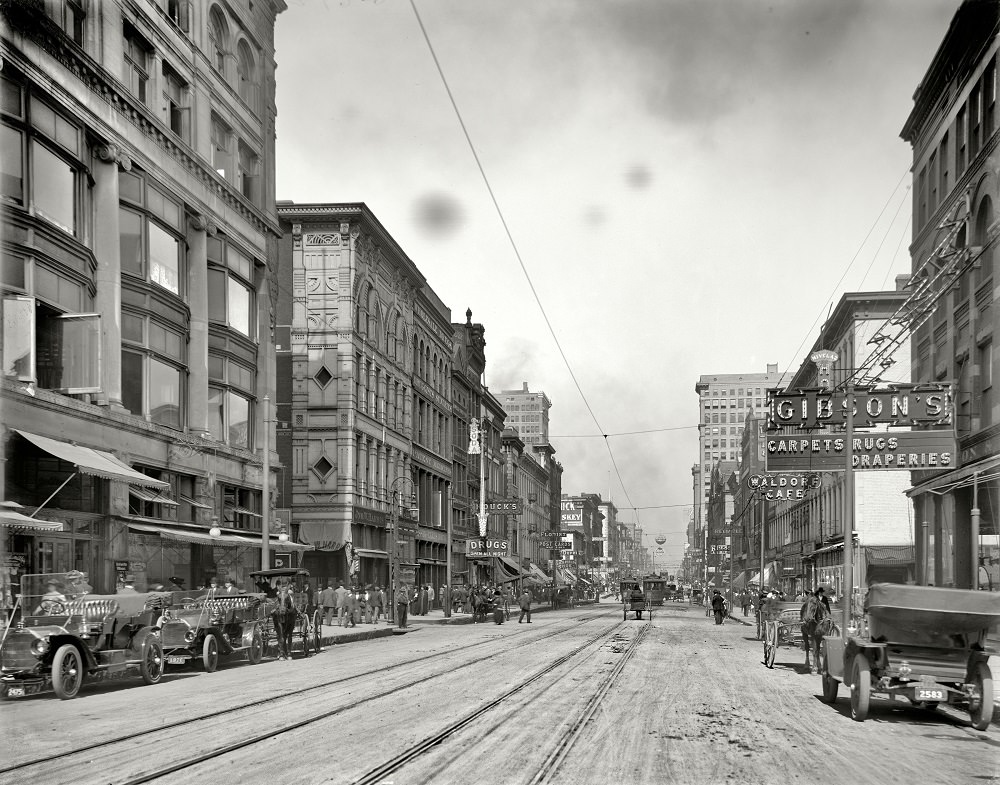
Looking north along Main Street from Gayoso Avenue, downtown Memphis appears as a busy commercial canyon of brick and stone storefronts, their tall façades catching the light above crowded sidewalks. Large painted and electric-style signs push into the street—advertising goods like drugs, carpets, rugs, and draperies—while awnings shade display windows at ground level. Overhead wires and the long, straight sightline emphasize just how built-up and modern the city center had become by the early 20th century.
Streetcar tracks run down the middle of the roadway, guiding the eye toward distant mid-rise buildings and a haze of urban activity. The traffic tells a story of transition: automobiles line the curb and move through the frame, yet horse-drawn vehicles still share the street, and pedestrians weave between commerce and transit. Dust and ruts in the road surface hint at the daily wear of heavy use, long before smooth asphalt became the norm.
For anyone interested in Memphis history, Main Street history, or early 1900s American city life, this 1910 view offers rich details in architecture, signage, and street infrastructure. It captures a moment when retail districts were dense and walkable, powered by streetcars and shaped by constant foot traffic. Seen today, the scene reads like a snapshot of a city confidently stepping into a new century while still carrying traces of the one before.