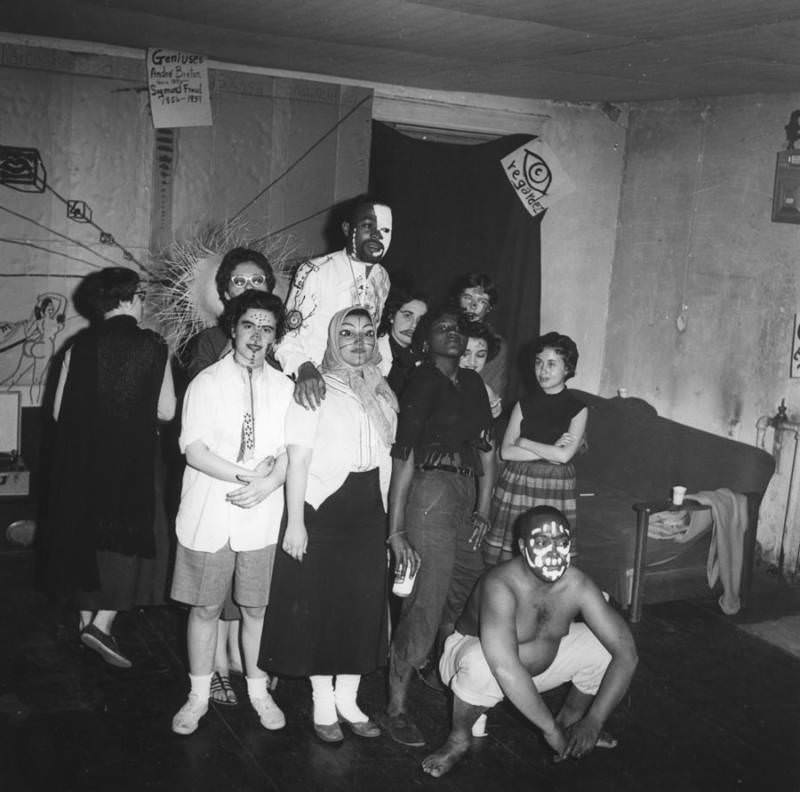
Greenwich Village in 1960 comes alive in a crowded room where costumes, face paint, and playful posing turn a simple gathering into a small theater of the downtown scene. A hand-lettered backdrop and taped-up signs hint at a makeshift venue—part apartment, part happening—while friends cluster together in the easy intimacy of a late-night party. The mix of masks and everyday clothing suggests a space where experimentation was normal, and where art could spill out of poems and songs into the way people dressed and moved.
At the center of the title’s story is Ted Joans, remembered as both poet and trumpeter, standing among revelers as if the night itself were a performance. The camera’s flash catches expressions ranging from amused to solemn, creating a lively contrast between staged costume and candid personality. Details like painted faces, a crouched figure in the foreground, and the tightly packed group portrait evoke the era’s bohemian energy and the informal social networks that sustained it.
Beyond the party atmosphere, the photograph reads as a social document of mid-century New York counterculture, where jazz, poetry, and visual art frequently overlapped. It’s a glimpse into how Greenwich Village communities gathered—improvising spaces, inventing identities, and celebrating one another with the same spirit that fueled the city’s creative scenes. For readers searching the history of Ted Joans, beat-era nightlife, or Greenwich Village culture, this image offers a vivid, human-scale window into that world.