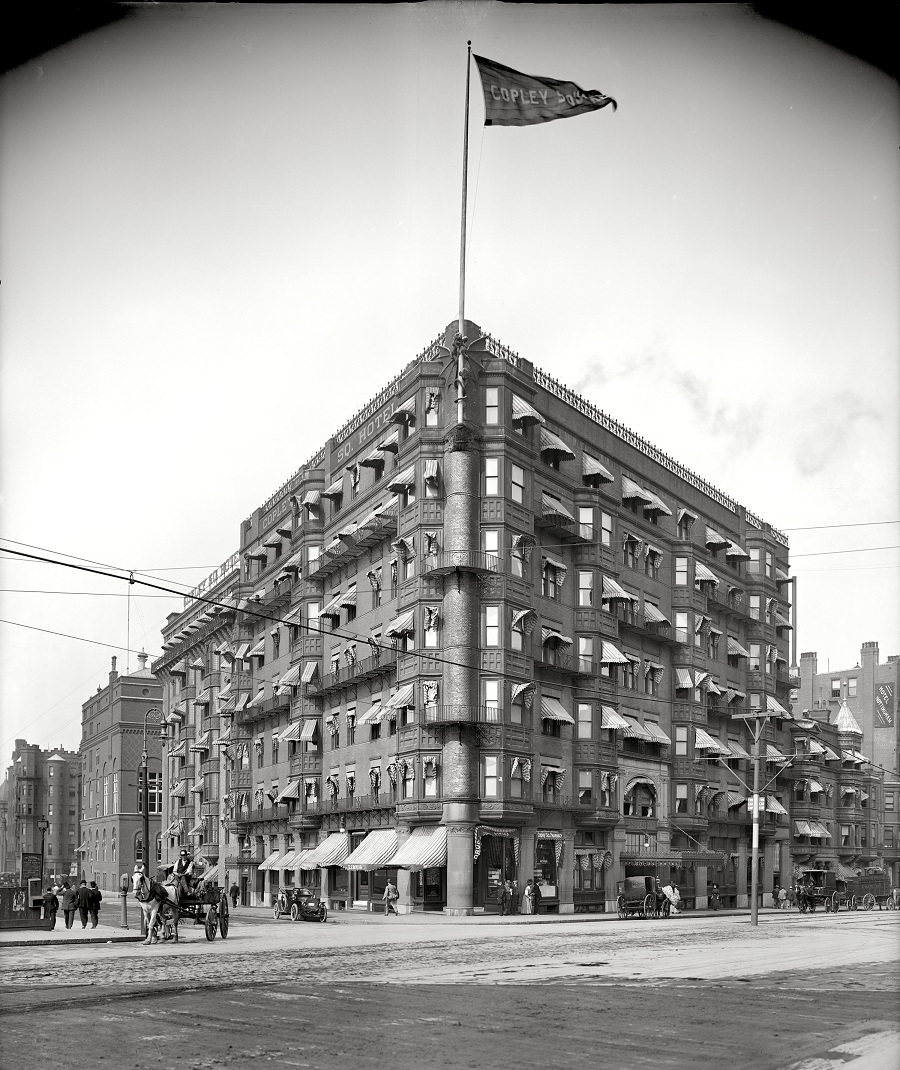
Rising above the street grid of Copley Square, the Copley Square Hotel presents itself as a proud, many-windowed landmark, its corner tower capped by a tall flagpole and a banner that reads “COPLEY.” Rows of striped awnings march across the façade, softening the building’s hard masonry lines and hinting at the comforts promised inside. From this angle, the hotel’s massing feels both elegant and practical—built to be noticed, yet designed for the steady rhythm of guests arriving day after day.
Street life at the base of the hotel anchors the scene in early-20th-century Boston, where pedestrians cluster near the curb and horse-drawn vehicles share space with the occasional automobile. Overhead, the web of trolley wires cuts across the sky, a reminder of how streetcars stitched neighborhoods together and funneled travelers toward busy squares like this one. The wide roadway and open intersection give the photograph a sense of movement, as if the city is always mid-transition.
For anyone exploring Boston history, Copley Square, or the evolution of American hotels, this 1909 view offers a vivid snapshot of urban change without needing a single captioned face. Architectural details—corner bays, decorative roofline work, and the repeating awnings—speak to the era’s blend of style and commerce. It’s an image that invites lingering: a familiar city intersection made newly interesting by the textures of transportation, street fashion, and the commanding presence of a well-known Boston hotel.