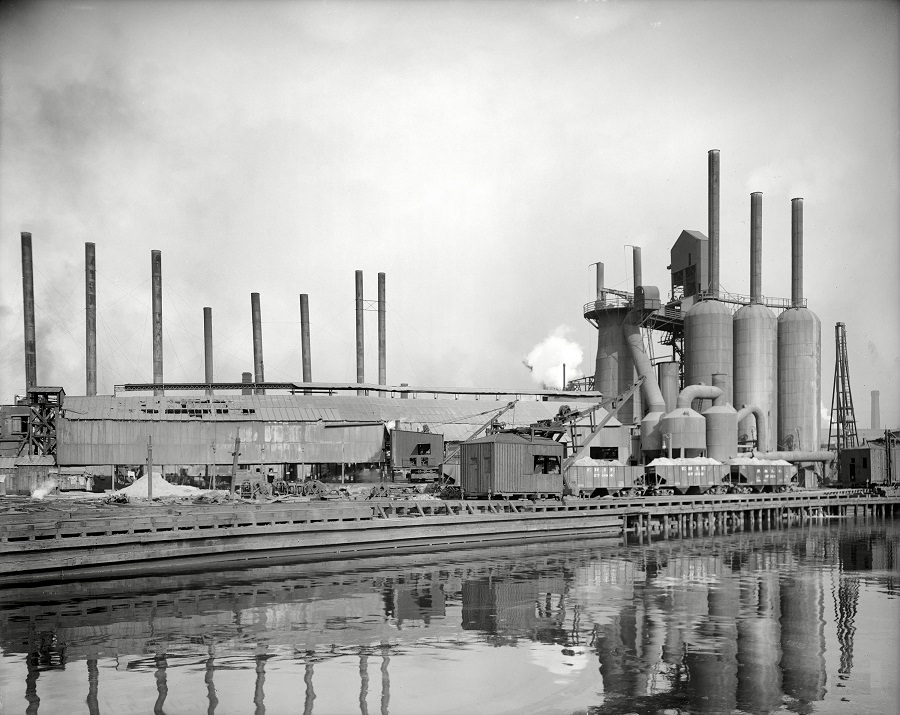
Rising above a quiet stretch of water, the Central Furnace Works complex in Cleveland reads like a skyline built for production—rows of smokestacks, long sheds, and towering cylinders stitched together by catwalks and pipes. The still surface in the foreground mirrors the plant’s hard geometry, hinting at how closely heavy industry and the waterfront were intertwined. Even at a distance, the scene communicates scale: an industrial landscape designed to run continuously, with every structure shaped by heat, fuel, and flow.
Along the ground line, sheds and service buildings sit in the shadow of larger furnaces and stacks, while pale plumes drift into a hazy sky. The mix of tall chimneys and clustered vessels suggests the dense infrastructure behind iron and steelmaking, where blast furnaces, gas handling, and power systems worked in concert. Details like rail lines and a rugged shoreline edge point to the logistics that fed the works—materials in, finished output out—making this a strong visual document of Cleveland’s industrial era.
For readers exploring early 20th-century Cleveland history, this circa-1908 view offers more than a factory portrait; it’s a snapshot of the city’s identity as a manufacturing powerhouse on the Great Lakes. The photograph balances “places and people” in an indirect way, letting the built environment stand in for the workers whose routines kept such plants alive. As an SEO-friendly reference point for Central Furnace Works, Cleveland industry, and waterfront manufacturing, it invites closer attention to how industrial architecture reshaped the urban landscape.