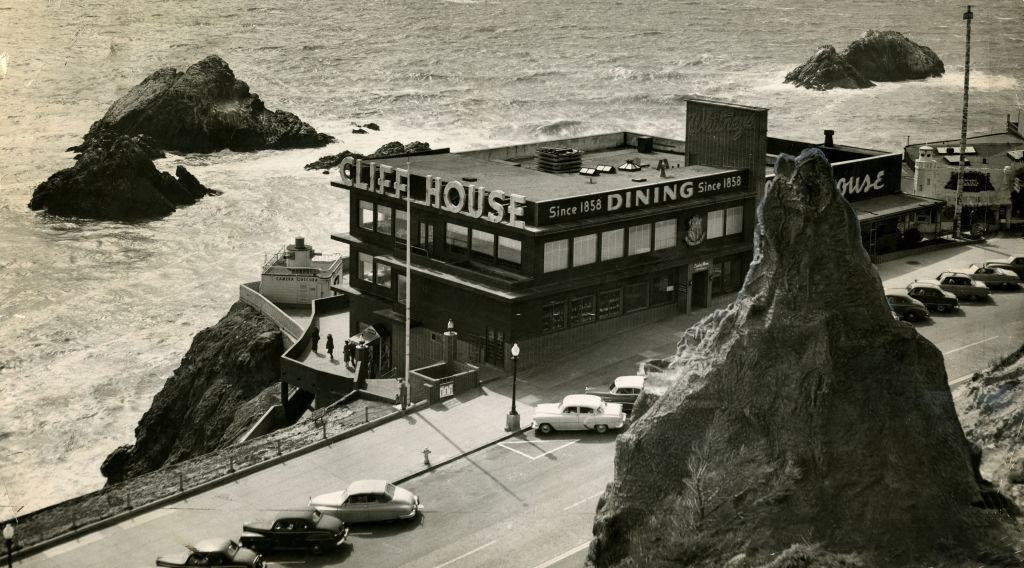
Perched above the surf at Ocean Beach, San Francisco’s Cliff House appears here as a confident mid-century landmark, its bold rooftop lettering and broad windows facing the Pacific. The building’s long, low lines read like a lookout post for the city—equal parts restaurant, viewpoint, and coastal icon—while the sea stacks and foaming water below remind you how close the edge really is. Even in stillness, the scene suggests wind, salt, and the steady rhythm of waves meeting rock.
Along the roadside, a row of period automobiles and a few small figures on the walkway hint at an everyday kind of pilgrimage: visitors arriving to eat, to gaze, or simply to say they’d been there. Signs advertising dining and the establishment’s long history frame the Cliff House as a place built on tradition, yet firmly of its time in 1954. The composition balances human-scale details—lamps, railings, pavement—with the dramatic natural theater of the coastline.
For anyone searching “Cliff House San Francisco 1954,” this photo offers a vivid snapshot of how the famous restaurant and viewpoint fit into the city’s shoreline landscape in the postwar years. The contrast between clean architecture and rugged cliffside captures what has long made this corner of San Francisco memorable: a civic gathering place set against an untamable ocean. Seen through this lens, the Cliff House reads not just as a building, but as a chapter in the ongoing story of places and people at the water’s edge.