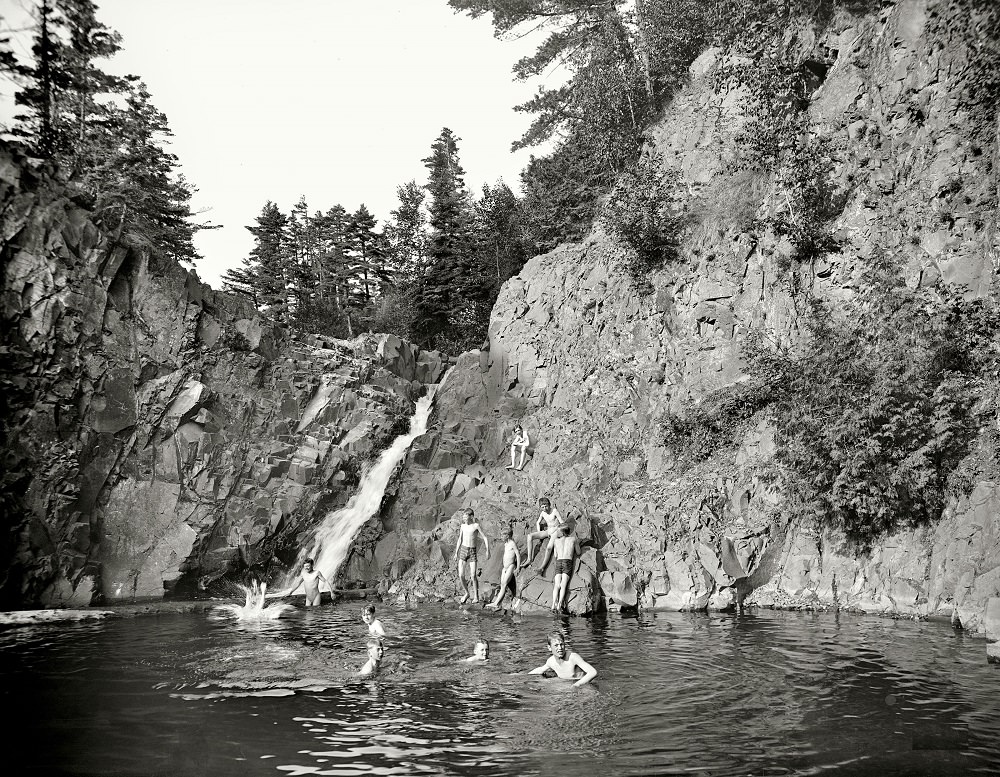
Tucked between steep rock walls, the swimming hole at Lester Park feels like a natural amphitheater carved by water and time. A narrow cascade spills down the dark stone into a calm basin, while tall pines crowd the rim above, softening the rugged shoreline with North Shore greenery. Even in monochrome, the textures stand out—wet rock faces, rippled water, and the bright sky opening over the gorge.
Along the edge, a cluster of swimmers balances on ledges and boulders, their bathing suits and relaxed stances hinting at an unhurried summer outing in early-1900s Duluth. Some wade and float near the foreground while others climb for a better view or a braver jump, turning the cliffside into an informal playground. The scene reads as both recreation and rite of passage, a place where local youth could test their nerve in a landscape that demanded respect.
For anyone searching the history of Lester Park, Duluth, Minnesota, this circa-1904 photograph offers more than “places and people”—it preserves a particular relationship between the city and its wild water. Before modern amenities and crowded beaches, a rocky pool like this could serve as a community gathering spot, cooled by the stream and framed by forest. It’s a reminder that outdoor leisure has long been woven into Duluth’s identity, shaped by the very terrain that makes the region memorable.