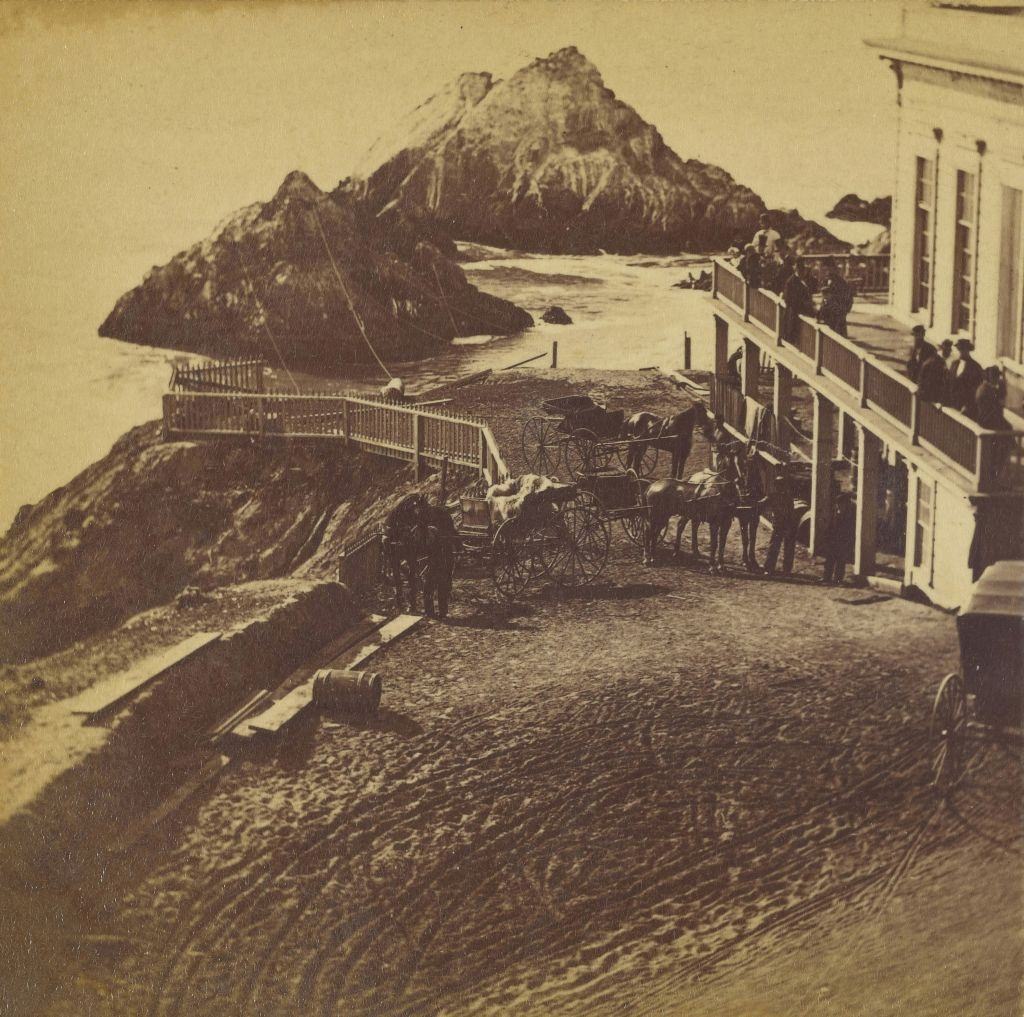
Perched at the ocean’s edge, the Cliff House appears here as both refuge and spectacle, its veranda crowded with visitors leaning out toward the surf. Offshore, dark rock formations rise from the water like sentinels, emphasizing the rugged drama that made this corner of San Francisco so magnetic to sightseers. The title’s year, 1867, places the scene in an era when coastal travel was still an event—part adventure, part social outing.
Along the sandy approach, horse-drawn carriages and wagons cluster near the building, suggesting arrivals timed to the tides and the view. The fencing and walkway trace a careful boundary between hospitality and hazard, guiding guests close enough to feel the sea air without surrendering to the cliffs. Even without hearing it, the photograph seems to carry the rhythm of waves and the bustle of a busy day at one of the city’s most famous overlooks.
Details like the layered balconies, the compact crowd, and the windswept shoreline make this a rich window into early San Francisco tourism and everyday life at the waterline. For readers interested in California history, historic architecture, or the evolving identity of the Cliff House, the image offers a grounded sense of place—where nature’s force met the city’s growing appetite for leisure. It’s a reminder that long before modern highways and postcard stands, the Pacific still drew people to pause, gather, and look out.