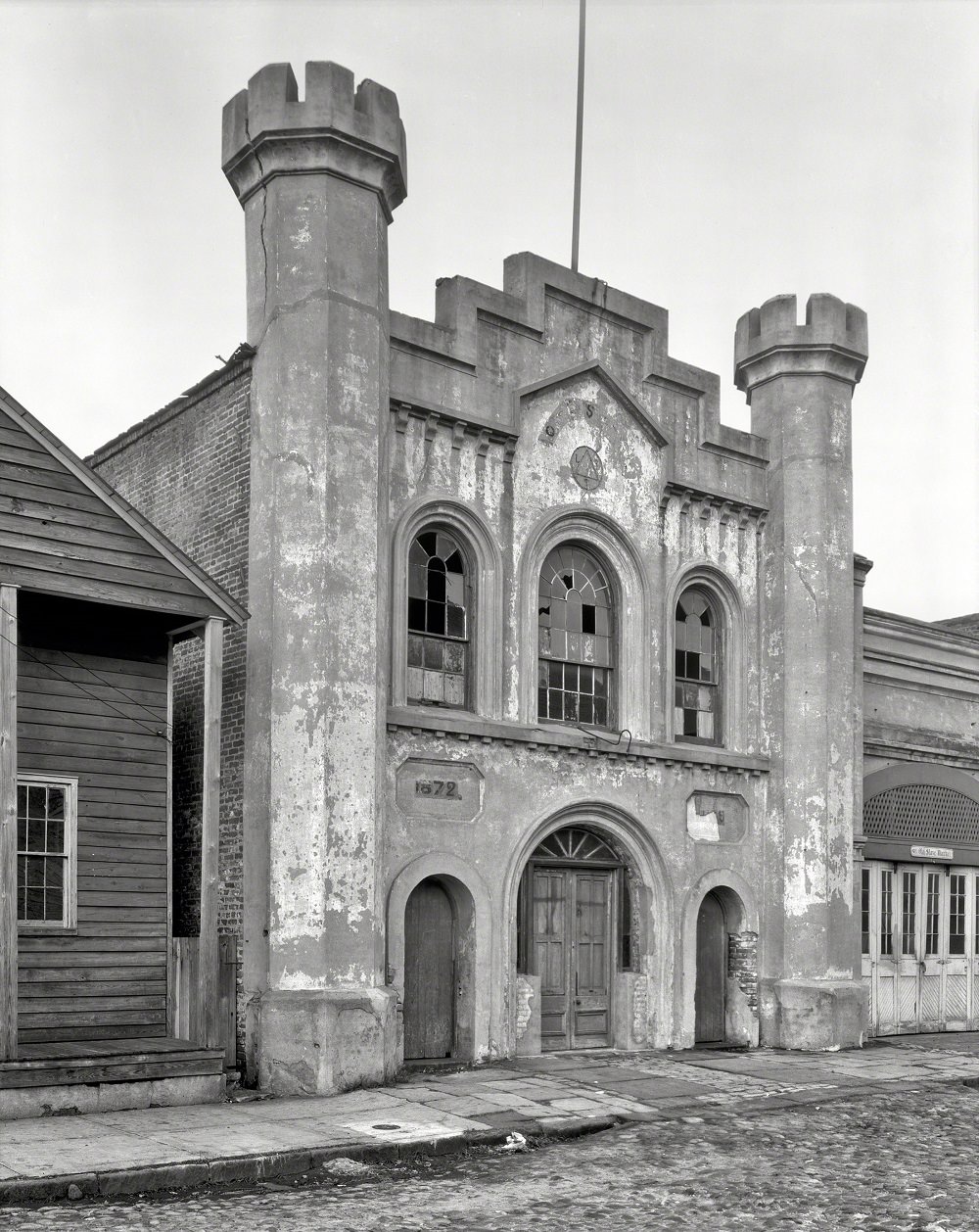
Stone and stucco rise like a small fortress on Chalmers Street, where Charleston’s Old Armory stands with squat corner towers and a crenellated roofline that feels borrowed from medieval imagery. The façade is worn and mottled, its surface flaking in patches that reveal decades of weather and use, while the tall arched windows—some visibly broken—hint at rooms that once echoed with drilling, storage, or civic activity. Even in 1937, the building’s stance is unapologetically solid, a piece of martial architecture adapted to a narrow city street.
Look closely and the details reward attention: the paired towers frame a central section with decorative molding and a faint emblem set above the upper windows. A date panel reading “1872” is visible on the front, anchoring the structure’s older origins even as the photograph captures it in a later chapter of its life. Heavy double doors sit beneath a broad arch, and the cobblestone roadway and uneven sidewalk in the foreground place the armory firmly in the everyday texture of historic downtown Charleston.
What makes this scene compelling is the contrast between purpose and patina—an armory designed to project readiness, photographed at a moment when time has softened its edges. Set at 8 Chalmers Street, the building reads as both landmark and neighbor, tucked among more modest adjoining structures that emphasize its bulk and unusual silhouette. For anyone searching Charleston history, Chalmers Street architecture, or the story of the Old Armory in 1937, this image offers a richly textured glimpse of a city where public buildings carried symbolism as well as function.