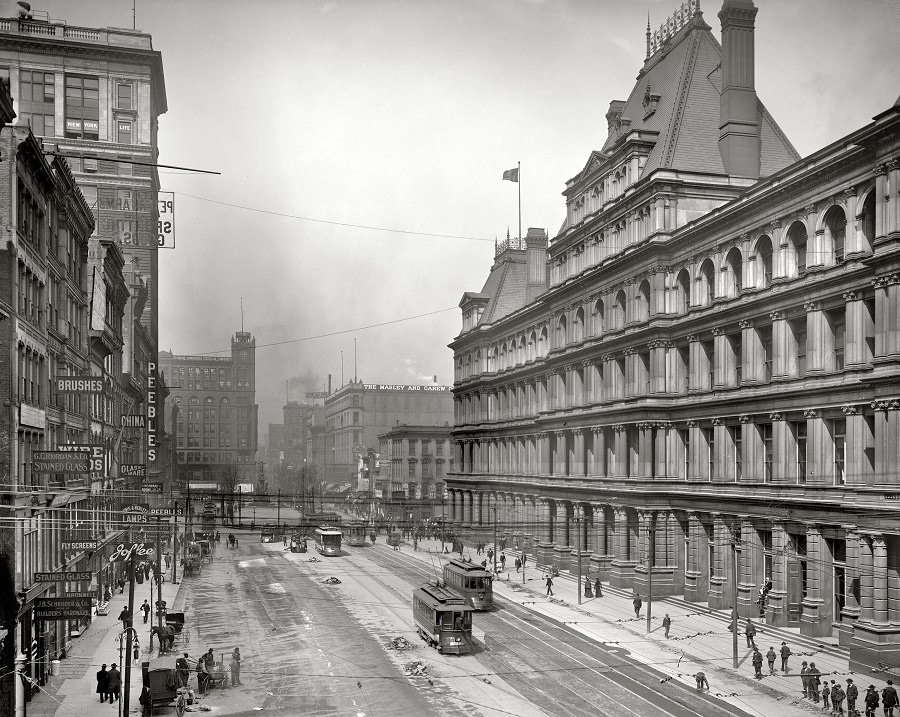
Government Square in Cincinnati comes alive here as a busy civic crossroads, framed by imposing masonry blocks and a grand roofline that signals the presence of a major public building. The wide street channels the eye toward the hazy distance where downtown structures stack up, their outlines softened by smoke and wintery light. For anyone searching Cincinnati history or early 20th-century streetscapes, the architecture alone is a rich catalog of the era’s confidence and ornament.
Streetcars glide along the rails at the center of the scene, their overhead wires webbing the sky and hinting at how electric transit reshaped daily movement through the city. Pedestrians cluster along the sidewalks and at corners, while wagons and curbside activity suggest the constant handoff between commerce and public life. Shop signs and window bands compete for attention on the left, creating the unmistakable texture of a working downtown where advertising, errands, and commutes overlapped.
Circa 1905, this view captures Government Square as both a destination and a thoroughfare—an urban stage where Cincinnati’s growth was visible in stone, steel, and street-level bustle. The photograph rewards close looking: the rhythms of transit, the layered storefronts, and the scale of civic architecture all speak to how the city presented itself at the height of the streetcar age. It’s an evocative piece for “Places & People,” grounding local memory in a recognizable intersection of government, business, and everyday footsteps.