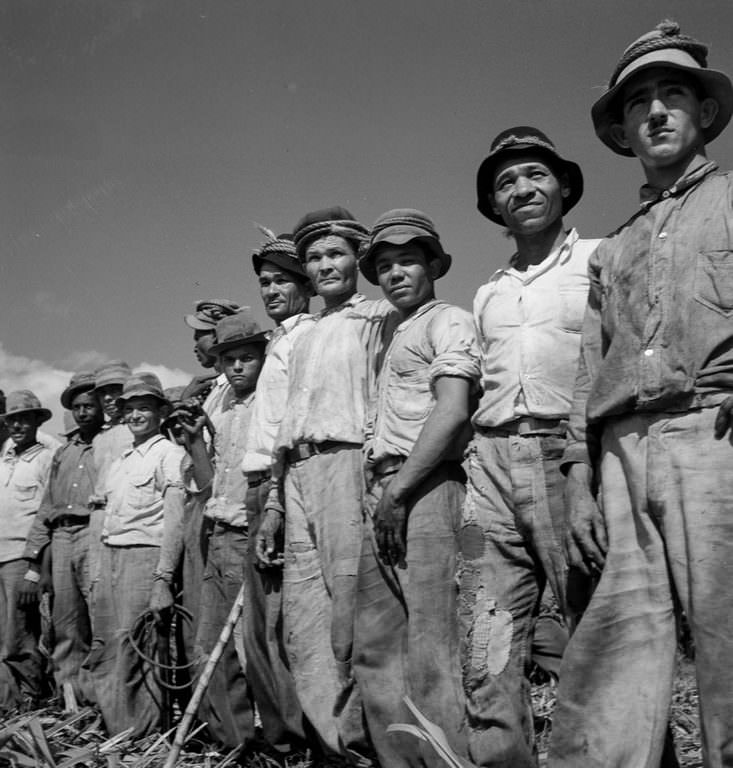
A line of field hands stands shoulder to shoulder under a wide, cloud-dotted sky, their work clothes sun-faded and dusted from the day’s labor. Brimmed hats and caps shade faces that meet the camera with a mix of weariness and resolve, while the cane leaves at their feet hint at the crop that has shaped so much of Puerto Rico’s rural economy. Set near Arecibo, the scene reads as both portrait and proof: a moment when working people became the central subject rather than the backdrop.
Cloth shirts cling and sleeves are rolled high, suggesting heat, humidity, and the physical rhythm of cutting and bundling sugarcane. The men’s stance—steady, slightly angled toward the lens—feels like a brief pause taken in the field, with tools and tangled stalks visible at the lower edge of the frame. As a historical photo of laborers on a sugar plantation, it draws attention to the everyday realities of agricultural work: long hours, shared routines, and a workforce formed by many backgrounds brought together by the demands of harvest.
Near Arecibo, sugar plantations once tied land, industry, and community life into a single powerful system, and images like this help us read that history through faces and fabric rather than statistics alone. The photograph invites viewers to look closely at posture, expression, and the details of dress to imagine what a workday felt like—what it required, and what it returned. For anyone exploring Puerto Rican history, plantation agriculture, or the lives of workers in the Caribbean, this is a stark, human-scale record worth lingering over.