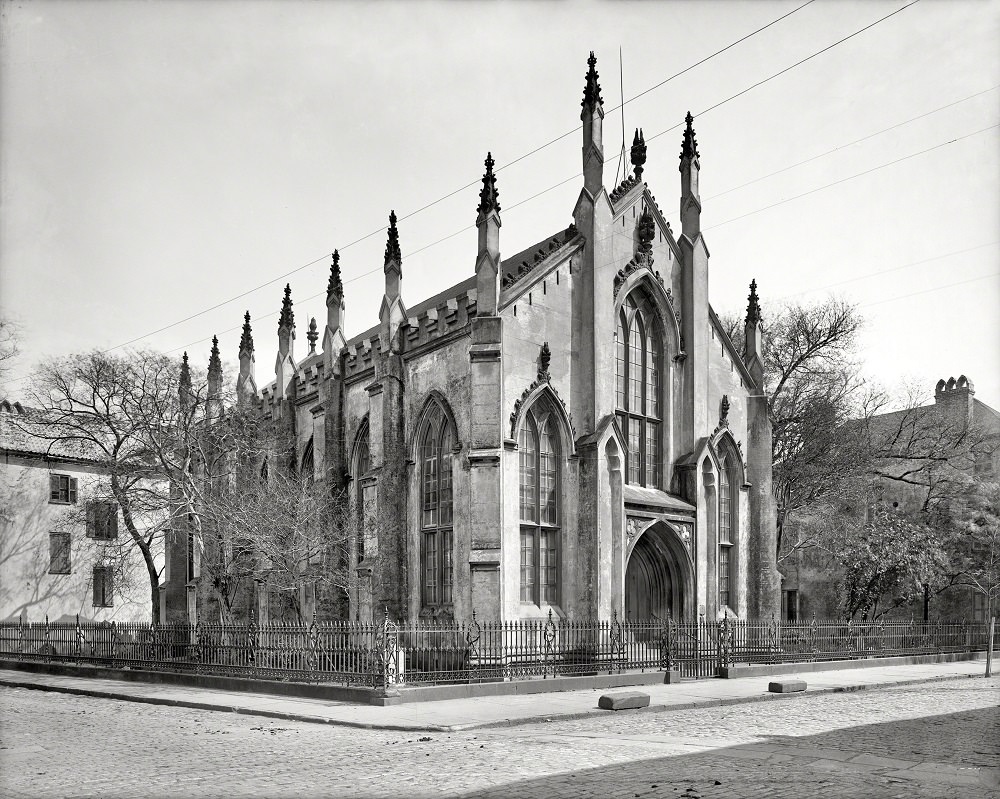
Rising behind an iron fence and bare-limbed trees, the Huguenot Church in Charleston stands with the crisp confidence of Gothic Revival design. Tall lancet windows march along the walls, while a row of slender pinnacles crowns the roofline like a stone comb. Even in a quiet street scene, the building’s pointed arches and steep gables give it a distinctly Old World silhouette set into the Lowcountry streetscape.
The 1904 view rewards a slow look: the entry porch frames a deep, shadowed doorway, and the large front window dominates the façade like a luminous panel waiting for stained glass to catch the sun. Cobblestone paving and a neatly kept perimeter suggest a cared-for landmark, more civic anchor than isolated sanctuary. Overhead utility lines trace faint diagonals across the sky, a small reminder that modern life was already threading itself through Charleston’s historic neighborhoods.
For readers interested in Charleston history and historic architecture, this photograph offers a grounded sense of place—sacred space meeting everyday city fabric. It’s an evocative glimpse of the Huguenot Church as a familiar local presence, defined as much by its streets and trees as by its buttresses and arches. As a piece of “places and people” history, the scene invites you to imagine the footsteps, services, and ordinary days that unfolded around these walls.