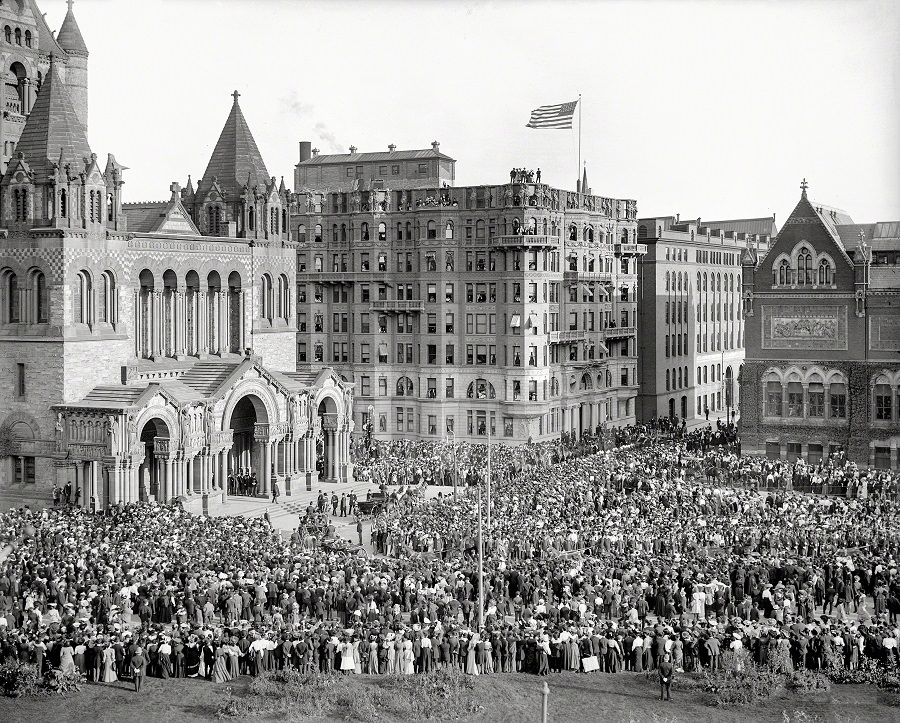
Crowds spill across Copley Square in Boston, pressing toward the arched entrance of Trinity Church as a formal party makes its way inside. The scale is striking: a dense sea of hats and dark coats in the foreground, lines of onlookers creating a corridor of attention, and faces turned toward the church doors where the “London honorables” are entering. Overhead, the American flag rises above the surrounding buildings, framing the moment as both civic spectacle and public ceremony.
Trinity Church’s Romanesque mass anchors the left side of the scene, its heavy stonework and towered rooflines contrasting with the taller commercial blocks behind. Windows, balconies, and rooftops appear crowded too, suggesting that the best view was worth any climb. The photograph doubles as an architectural snapshot of early-20th-century Back Bay, where landmark church design and modern urban development meet at one of Boston’s most photographed squares.
A visit by prominent British figures in 1903 offered Boston a chance to perform its identity on a grand stage—orderly, curious, and eager to witness history at close range. The image’s richness lies in the small details: the layered ranks of spectators, the careful spacing near the church entrance, and the city’s built backdrop acting like a theater set. For readers searching Boston history, Trinity Church, Copley Square, or 1903 public events, this photograph preserves the texture of a day when the square became a living audience.