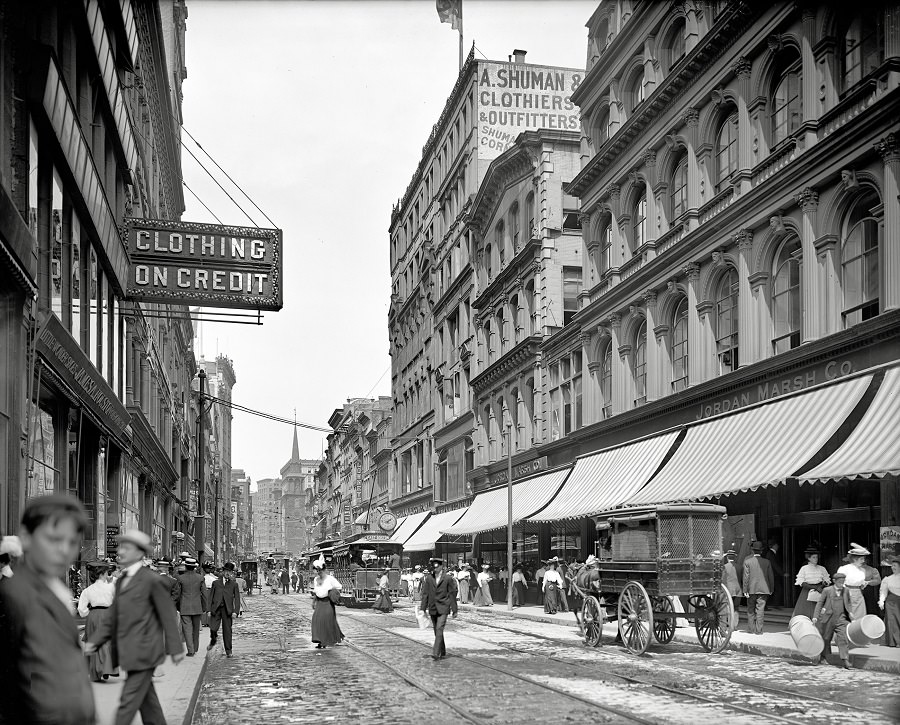
Washington Street north from Temple Place in 1906 reads like a busy ledger of city life, where storefronts, sidewalks, and streetcar tracks all compete for attention. Signs jut out over the cobbled roadway—“CLOTHING ON CREDIT” and the tall rooftop lettering for A. Shuman & Co., “Clothiers & Outfitters”—advertising the promises of a growing consumer economy. Long rows of multi-story commercial buildings frame the corridor, their windows and cornices creating a canyon of stone, glass, and ambition.
Along the street, pedestrians in early-20th-century dress move through a scene built for foot traffic and transit alike, with rails running straight down the center. A horse-drawn wagon pauses near the curb while awnings shade shop entrances, suggesting a retail district designed to keep customers circulating even in harsh light or weather. The mix of movement and stillness—people mid-stride, vehicles poised, and a dense background of commerce—gives the view the feel of a working day rather than a posed moment.
Details like the “Jordan Marsh Co.” name on the right-hand facade anchor the photograph in a recognizable world of department stores and downtown shopping. The perspective north from Temple Place emphasizes how tightly packed and vertical these streets had become by the early 1900s, with advertising rising above the roofline and architecture pressing in from both sides. For anyone researching Washington Street history, Boston streetscapes, or turn-of-the-century urban retail, this image offers a vivid snapshot of places and people sharing the same narrow stage.