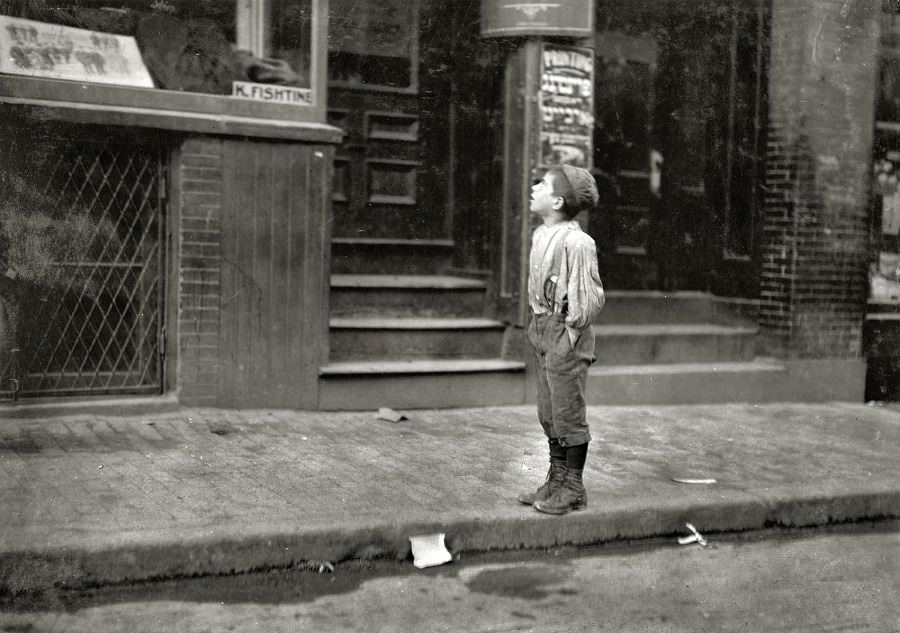
On a Boston sidewalk in 1909, a young boy in suspenders and sturdy boots pauses at the curb, chin lifted as if listening for a call or watching something unfold just out of frame. The street surface looks worn and uneven, with scraps of paper scattered near the gutter, small details that quietly evoke the everyday bustle of an early-20th-century city. Behind him, the recessed doorway and steps hint at a neighborhood shopfront or tenement entrance, the kind of threshold people crossed dozens of times a day.
Brickwork, window grilles, and a tightly framed storefront edge create a dense urban backdrop, while posted notices and signage add texture without giving away a specific address. The boy’s posture—hands tucked behind his back, weight set squarely—feels both candid and composed, capturing a moment of childhood stillness amid Boston’s constant motion. There’s an immediacy here that makes the scene feel less like a posed portrait and more like a slice of street life.
For readers searching Boston, Massachusetts history, this photograph offers a grounded glimpse of places and people at street level, where the city’s story was lived in brief pauses and routine errands. It invites questions about work, school, and neighborhood rhythms in 1909, when children often moved through public spaces with remarkable independence. As a historical photo for a WordPress post, it’s a compelling reminder that the past survives not only in landmarks, but in ordinary corners and the faces that once looked up from them.