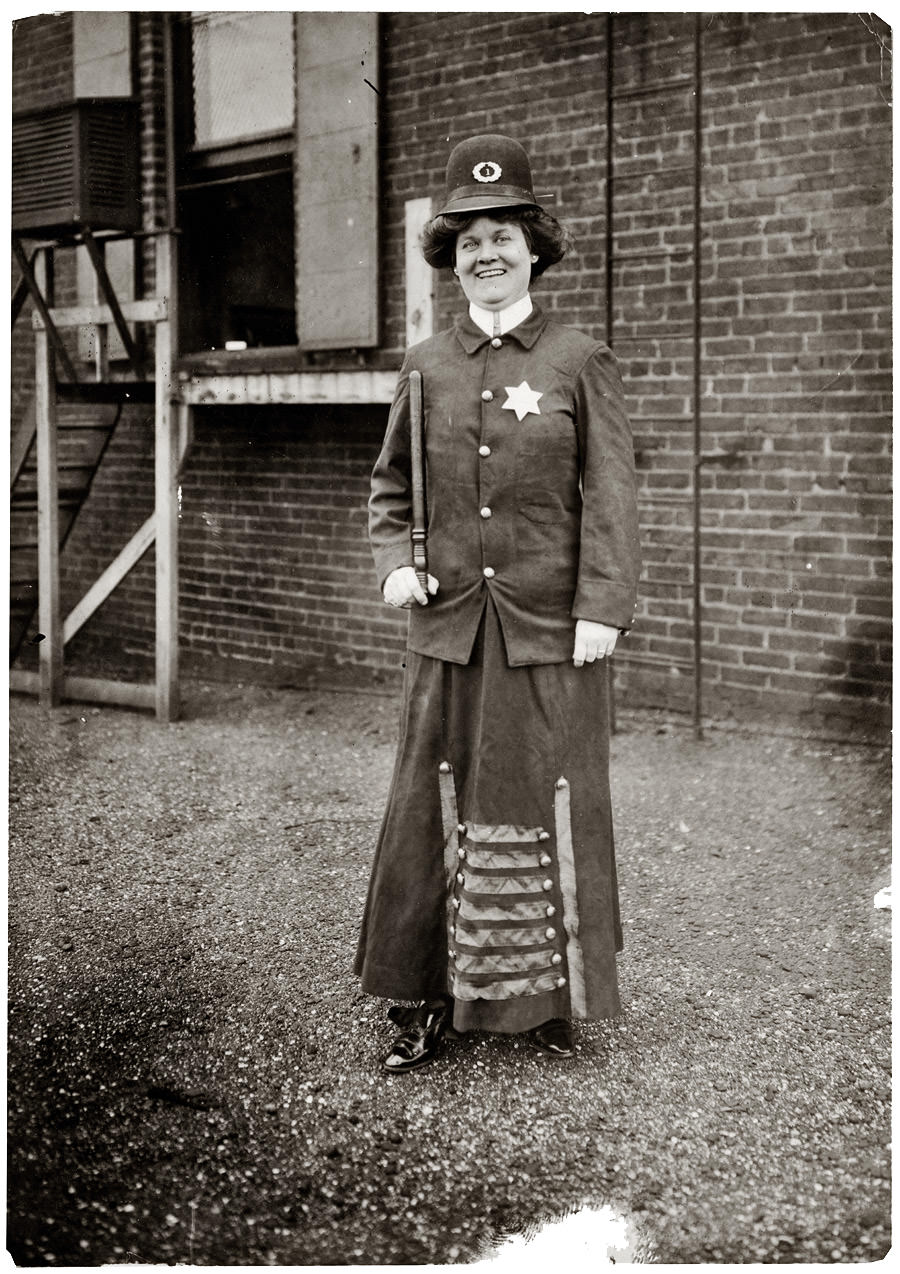
A confident suffragette stands outdoors in a police-style uniform, smiling directly at the camera as if daring viewers to imagine a different kind of public authority. The outfit’s crisp buttons, broad-brimmed hat, and prominent star badge create an unmistakable visual shorthand for law and order, while a baton-like object at her side reinforces the message. Behind her, a plain brick wall and industrial-looking window frame keep the focus on the figure and the idea she is meant to embody.
Dated in the title to Cincinnati on September 23, 1909, the photograph functions as more than a portrait; it reads like a deliberate illustration of the “woman police” concept at a moment when women were pushing for expanded civic roles. Suffrage activists often used bold symbolism to challenge assumptions about what women could do in public life, and adopting a uniform made that argument instantly legible. The contrast between the formal police attire and the long skirt typical of the era highlights how new responsibilities were being proposed within familiar social boundaries.
For modern readers searching for early women in policing, suffragette history, or Progressive Era reform imagery, this scene offers a vivid glimpse into the persuasive power of dress and performance. It invites questions about how audiences in 1909 would have reacted—whether with curiosity, approval, ridicule, or resistance—and how such staged photographs helped normalize once-unthinkable possibilities. As a piece of Places & People history, it preserves a moment when the vote and the badge could be imagined together, even before either was widely available to women.