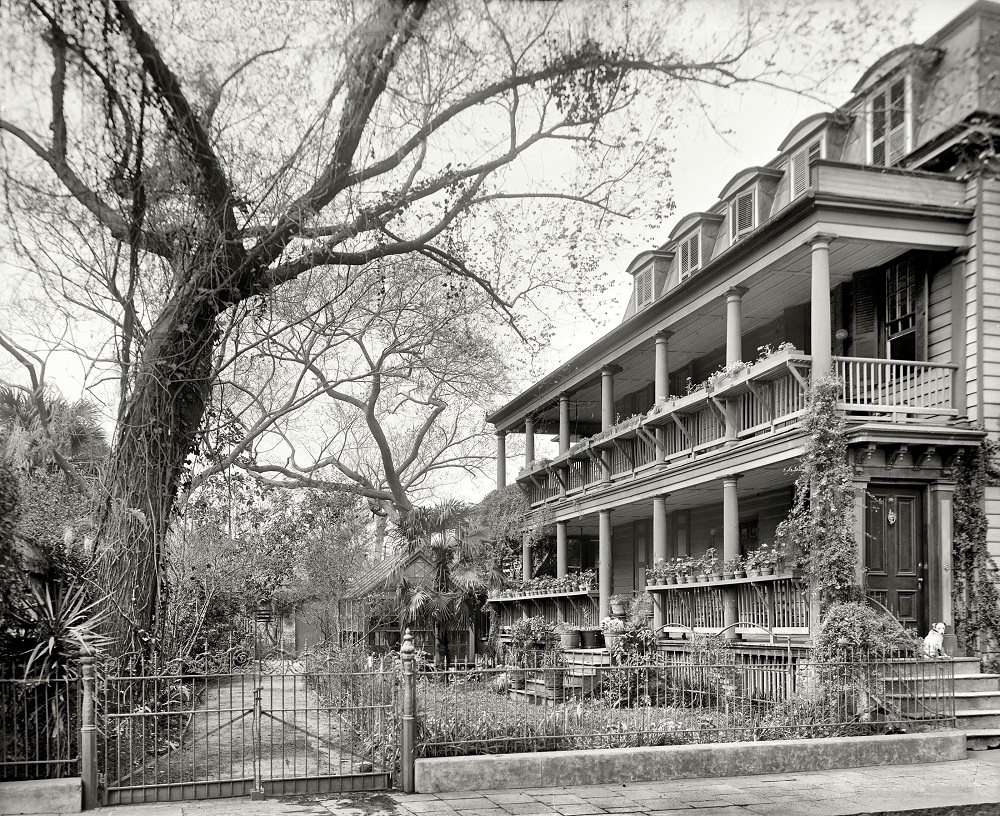
Legare Street in Charleston has long been a showcase for gracious domestic architecture, and the view at No. 35 in 1910 leans into that reputation. A broad, two-story piazza stretches across the façade, its slender columns and railings layered with porch plants, while dormer windows punctuate the roofline above. In the foreground, an iron gate and low wall mark the boundary between public sidewalk and the cultivated calm of a private yard.
The composition draws the eye first to the enormous tree on the left, its bare branches arching overhead like a canopy and softening the geometry of the house. Behind the fence, a narrow drive slips toward outbuildings and garden growth, hinting at the working landscape that often sat just beyond the formal face of Charleston residences. Vines and shrubs cling to the porch supports, giving the scene a lived-in, slightly wild texture that contrasts with the home’s orderly lines.
Set in the early twentieth century, this photograph reads as both an architectural record and a small slice of neighborhood life—quiet, shaded, and carefully tended. Details like the repeated porch bays, the clustered planters, and the gated entrance offer useful cues for anyone researching Charleston historic homes, Legare Street streetscapes, or the evolution of local residential style. Even without naming residents, the image preserves the atmosphere of a city block where gardens, galleries, and the slow rhythm of the street shaped everyday experience.