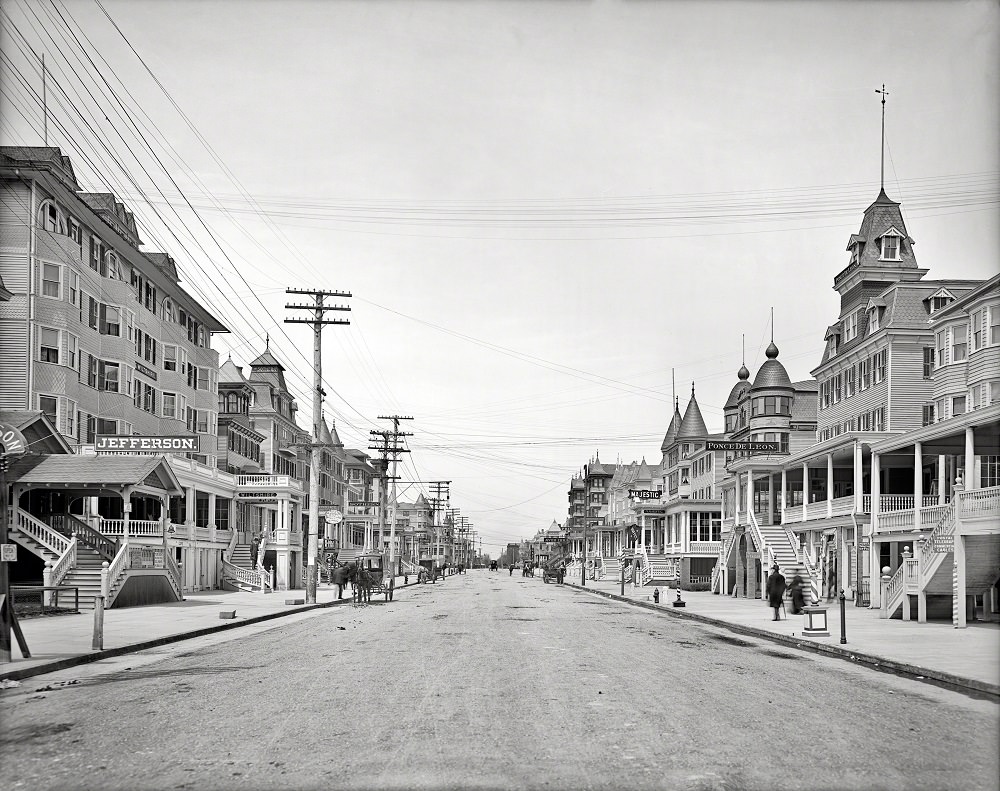
Virginia Avenue in Atlantic City, New Jersey appears here in 1904 as a wide, sandy corridor framed by towering seaside hotels and boardinghouses, their long porches and layered balconies stacked like theater boxes. Painted signs—“Jefferson” on the left and “Ponce de Leon” and “Majestic” on the right—anchor the scene in the resort economy that defined the city’s streetscape. The architecture is richly detailed, from mansard roofs to turrets and spires, signaling an era when lodging itself was part of the attraction. Overhead, a web of utility wires stretches between tall poles, an unmistakable marker of modern infrastructure threading through a leisure town. The road is largely open, with a few pedestrians and horse-drawn vehicles providing scale and a sense of everyday movement. That combination of grand buildings and sparse street traffic gives the view a calm, early-morning feel, as if the avenue is waiting for the day’s crowds to arrive. For anyone researching Atlantic City history, this photograph offers a strong visual record of urban growth at the shore—how hospitality, transportation, and street life met along a single straight line. It also invites close reading: the storefront-style signage, the repeating stairways up to porches, and the careful symmetry of buildings facing one another across the avenue. As a piece of New Jersey historical imagery, it captures both “places and people” in the subtle way old street scenes often do—through what was built, how it was labeled, and who moved through it.