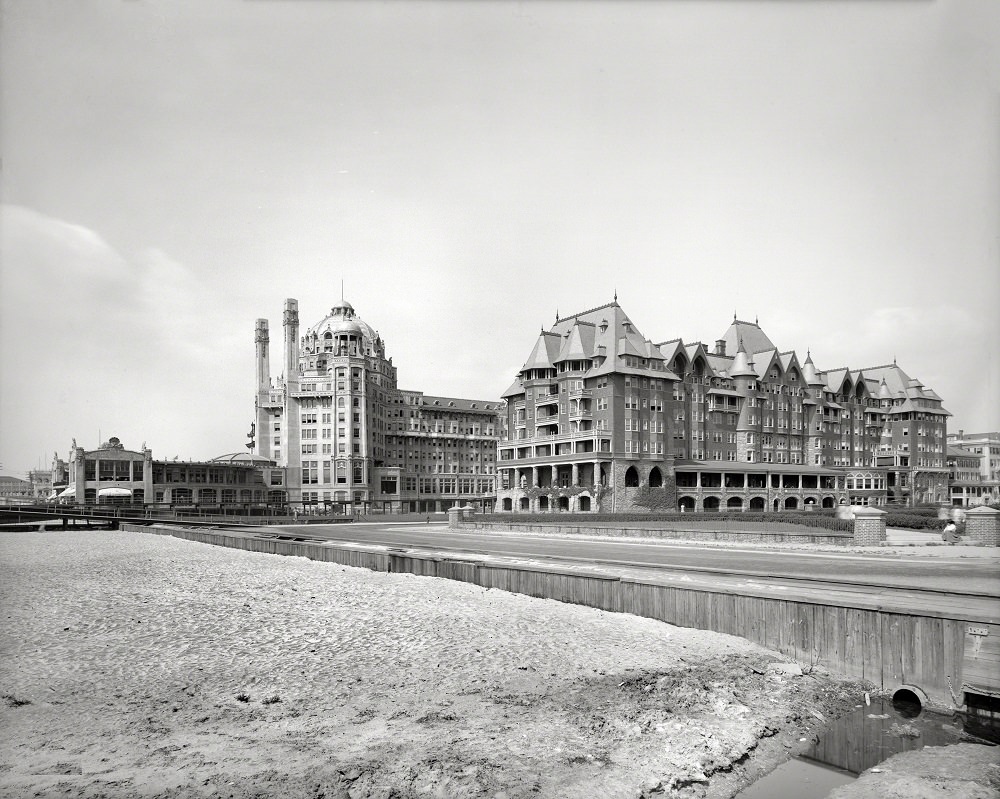
Rising above the flat sweep of sand and sky, the Marlborough-Blenheim Hotel dominates the Atlantic City shoreline with a silhouette built for spectacle. Its long facade, crowded with gables and dormers, reads like a seaside castle, while the neighboring tower and chimneys add an almost industrial note to the resort skyline. Even from a distance, the massing and ornament suggest how the Jersey Shore marketed itself in the early 1900s: grand, modern, and unmistakably aspirational. In the foreground, the boardwalk edge and dune barrier draw a clean line between leisure and the working realities of a coastal town. The wide, open beach feels nearly empty, giving the architecture room to perform, and the paved strip behind the sand hints at the steady flow of arrivals and promenading that defined Atlantic City’s peak resort years. Small structures along the left—likely services tied to the waterfront—underscore how much infrastructure was required to keep an oceanfront hotel district running. Around circa 1905, scenes like this helped cement Atlantic City’s reputation as a place where urban comforts met sea air and summer ritual. The photo serves as a valuable reference for anyone researching the Marlborough-Blenheim, early boardwalk-era development, or classic Jersey Shore tourism history. For collectors and local-history readers alike, it’s a crisp reminder of how hotels once shaped the horizon and the imagination of America’s coastal vacations.