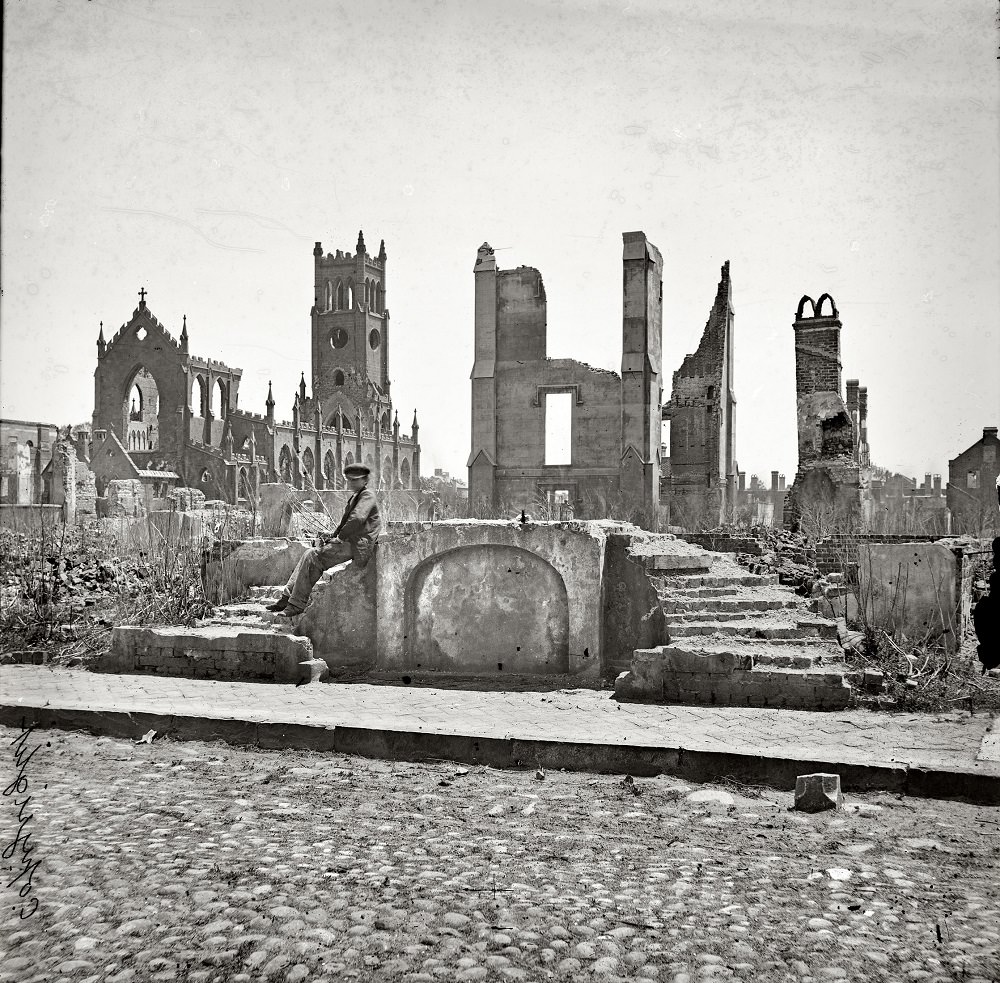
Charred masonry and open sky define this view of Charleston, South Carolina, in 1865, where the bombardment left the Cathedral of St. John and St. Finbar standing as a hollowed Gothic shell. The broken arches, jagged window openings, and battered tower line draw the eye across a landscape of collapse, with scattered brickwork and weedy growth reclaiming what had been ordered streets and church grounds. Even at a distance, the surviving architectural details hint at the craftsmanship and ambition that once shaped this landmark before war reduced it to ruins.
In the foreground, a lone figure sits on a low wall beside fractured steps, giving scale to the devastation and adding a quiet, human pause to the scene. Around him, partial facades rise like stage sets—chimney stacks, isolated walls, and truncated corners—suggesting whole blocks erased while stubborn fragments remain. The cobbled street and broken curb emphasize how thoroughly daily life was interrupted, turning familiar urban infrastructure into a tableau of loss.
Seen today, the photograph functions as both documentation and warning, a Civil War-era record of Charleston’s wartime damage and the vulnerability of sacred spaces amid military conflict. Readers searching for “Charleston after the bombardment,” “Cathedral of St. John and St. Finbar ruins,” or “1865 Charleston photograph” will find here a stark, detailed reference point for understanding the city’s battered built environment at the end of the war. More than a study of architecture, it is a portrait of a community standing among remnants, facing the long work of memory and rebuilding.