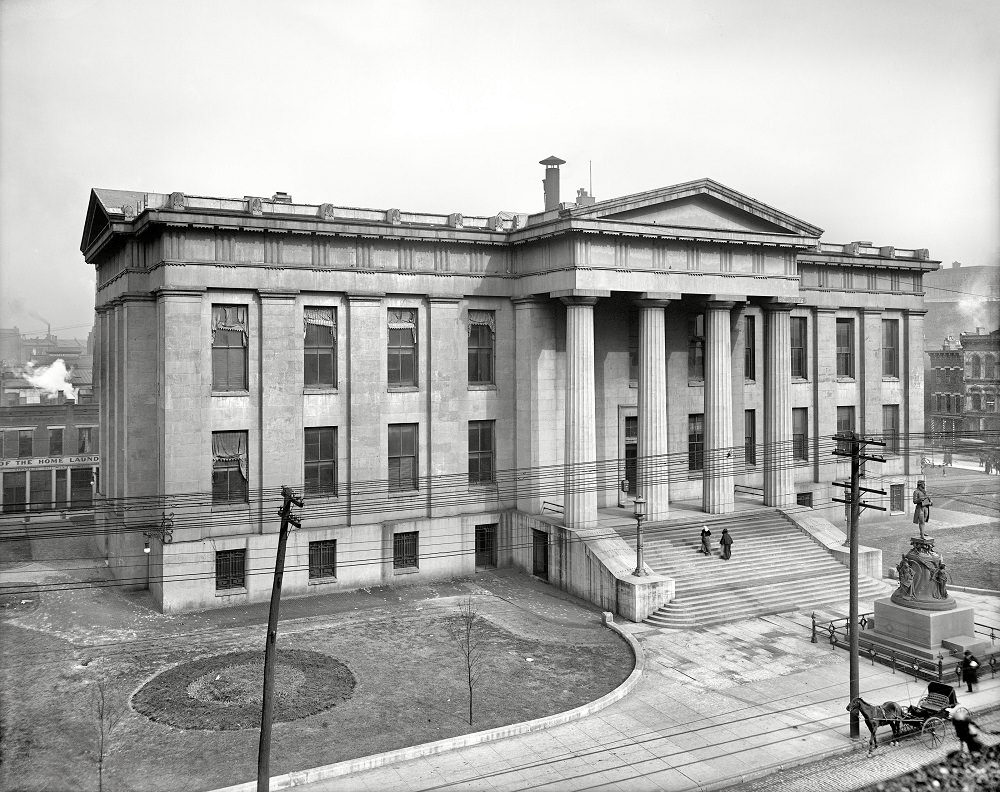
Towering columns and a broad pediment give Louisville’s courthouse the confident look of a civic temple, a style meant to signal permanence and authority. The 1906 view lingers on clean lines, tall windows, and the careful symmetry of the façade, while overhead utility wires slice across the scene as a reminder that modern infrastructure was already threading through the city. At street level, the open grounds and curving paths soften the building’s severity, framing it as both a working center of government and a public landmark.
Off to the right, the Thomas Jefferson statue anchors the foreground, placing a familiar national figure in the local landscape of downtown Louisville. The monument’s heavy base and sculptural details contrast with the courthouse’s plain stone surfaces, suggesting how public memory and public administration shared the same stage. A few figures on the steps provide scale and a hint of everyday rhythm—people moving in and out of official spaces, beneath architecture designed to impress.
Seen as a whole, this historic Louisville photo offers more than a record of a single building; it captures an era when American cities balanced classical ideals with rapid urban change. The mix of monumental architecture, street activity, and visible transit—horse-drawn traffic alongside the web of lines overhead—makes the scene especially valuable for readers interested in Kentucky history, courthouse architecture, and early 20th-century civic life. For anyone tracing Louisville’s built environment, the courthouse and Jefferson statue stand as a striking snapshot of how the city presented itself in 1906.