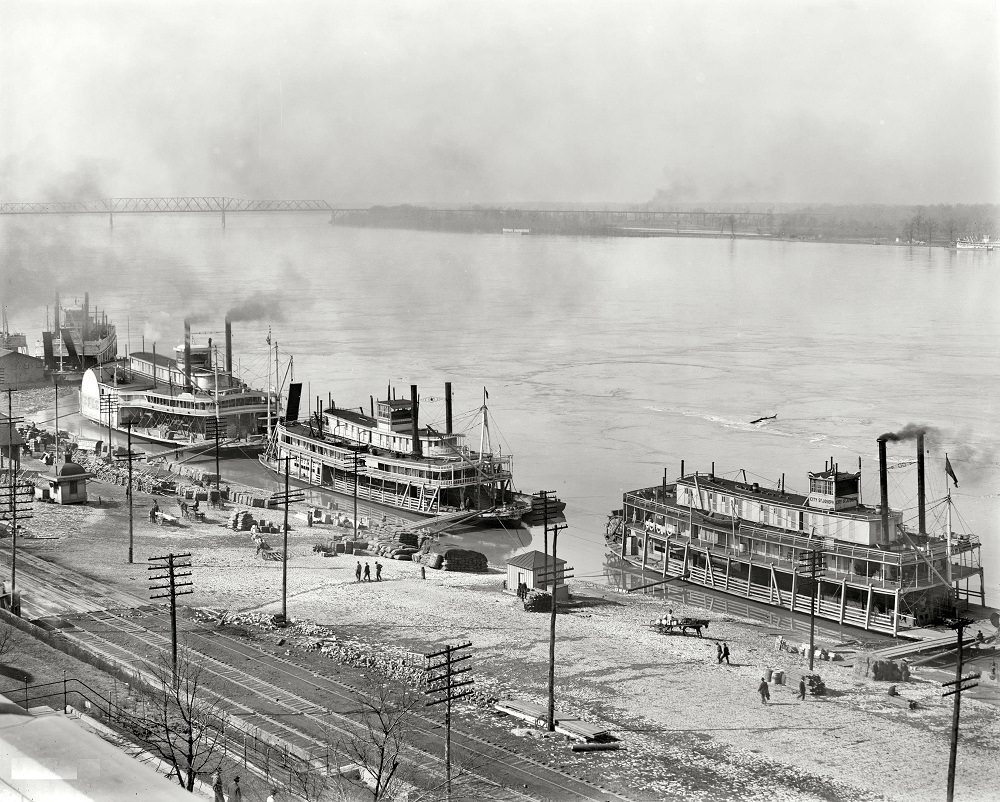
From the Custom House looking down to the Mississippi River levee in Memphis, this circa‑1900 view opens onto a waterfront built for motion and exchange. Several large steamboats lie moored along the bank, their tall stacks sending pale smoke into the river air, while the broad channel stretches toward a distant bridge and a hazy opposite shore. The scene feels both expansive and crowded—an urban riverfront where water, industry, and daily life meet at close range.
Along the levee, the ground is busy with the physical work of commerce: stacked freight, scattered equipment, and small figures moving between the landings and the boats. Rail lines and telegraph poles cut across the foreground, underscoring how Memphis connected river traffic to inland routes, and how quickly goods could move once they left the wharf. Even without pinpointing individual faces, the photograph reads as a snapshot of labor—loading, unloading, waiting, watching—played out on a wide, open stage.
Memphis’s riverfront history is written in places like this, where steamboat travel, shipping, and municipal authority converged within sight of the Custom House. The levee served as a practical boundary and a social crossroads, shaped by the seasonal moods of the Mississippi and the demands of a growing city. For anyone searching for historic Memphis, Tennessee photographs or Mississippi River steamboat scenes, this image preserves the texture of an era when the river still set the rhythm of waterfront life.