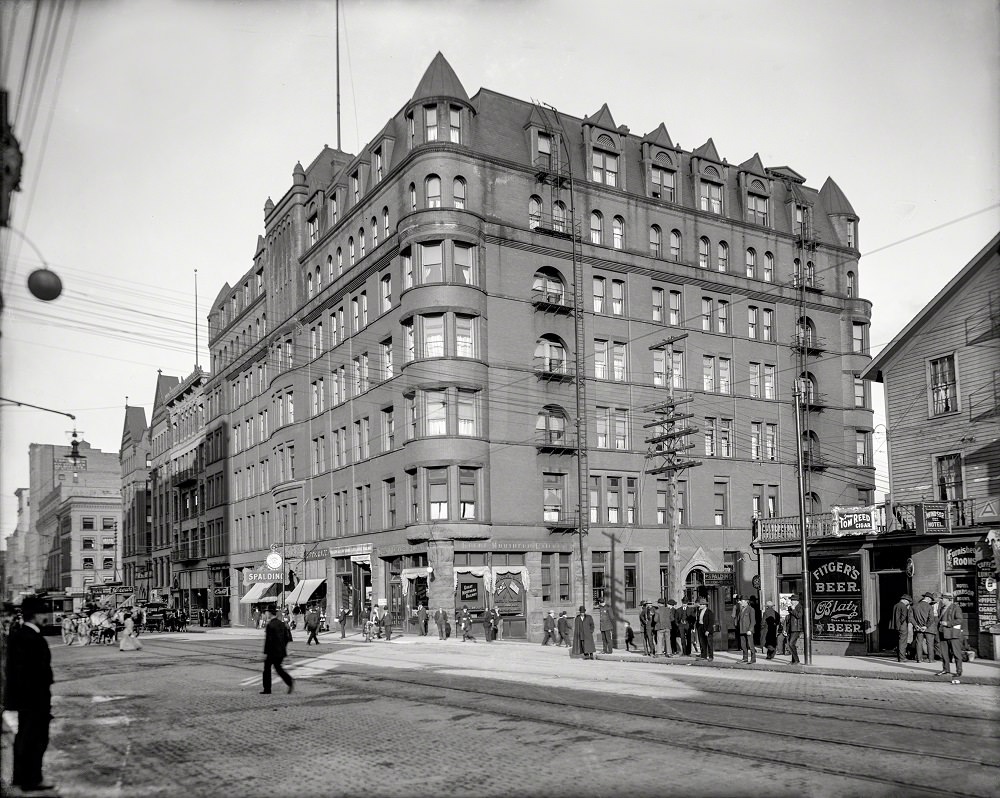
Rising over the street like a small city of its own, the Spalding Hotel dominates this 1908 view of downtown Duluth, Minnesota. The building’s rounded corner, rows of evenly spaced windows, and steep roofline with turreted peaks speak to an era when hotels were designed to impress arriving visitors as much as to house them. At ground level, awnings and storefront entrances hint at the everyday commerce that clustered around big lodgings, where travelers could step from sidewalk to lobby without ever leaving the bustle behind.
Along the curb and across the broad roadway, street life unfolds in crisp detail: pedestrians pausing in groups, a few figures striding through the open space, and utility poles laced with overhead wires that frame the scene. The street surface shows the wear and texture of constant use, while signage for nearby businesses adds a lively patchwork of lettering and advertisement. Together, these elements create a vivid snapshot of early 20th-century urban rhythm, when hotels, shops, and transit lines helped knit Duluth’s waterfront economy to its downtown streets.
For anyone researching Duluth history, Minnesota architecture, or the changing face of American city blocks, this Spalding Hotel photograph offers more than a landmark—it offers context. The scale of the structure against the smaller neighboring buildings underscores how prominent hotels anchored business districts, serving as meeting places, temporary homes, and symbols of civic ambition. As you look closer, the mix of people, storefronts, and infrastructure turns “Places & People” into a lived moment, capturing how Duluth appeared and moved in 1908.