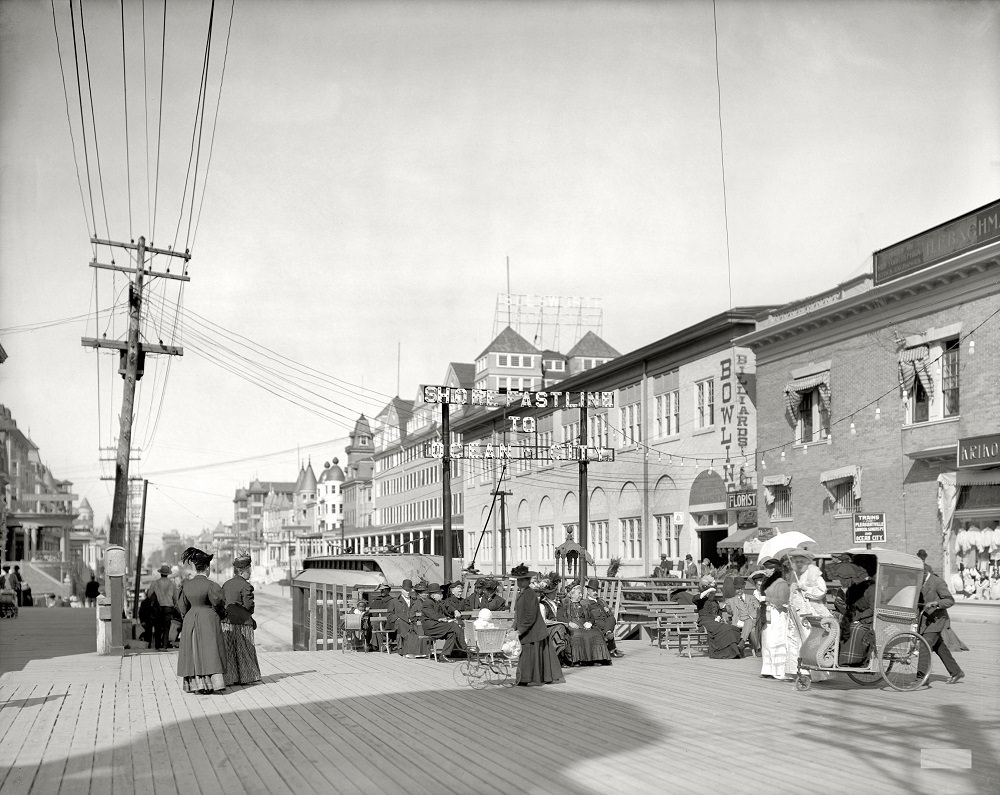
Virginia Avenue opens out from the Atlantic City boardwalk in 1908 with the easy confidence of a resort at full stride. Broad wooden planks lead the eye past trolley tracks and a forest of utility poles and overhead wires, while large hotels and commercial blocks stack the horizon in layered facades. A prominent sign for a shore-to-inland rail connection hints at how visitors arrived and how closely the seaside economy depended on transportation. Along the right-hand storefronts, striped awnings, display windows, and painted signs create a lively streetscape where businesses catered to passing crowds. The scene is crowded with everyday details—benches clustered near the curb, a flower shop sign, and the steady flow of pedestrians moving between street and boardwalk. In the distance, turreted rooftops and long verandas evoke the architectural mix that made Atlantic City’s hotel district instantly recognizable. People, as much as the buildings, define the moment: groups linger to talk, couples stroll, and a wheeled chair or carriage is guided carefully along the boards. Clothing and posture suggest a day of leisure, yet the street’s infrastructure—rails, wires, and transit signage—reminds us that this was also a working corridor of modern city life. For anyone researching Atlantic City history, the Virginia Avenue view captures a coastal crossroads where tourism, commerce, and technology met on the edge of the sea.