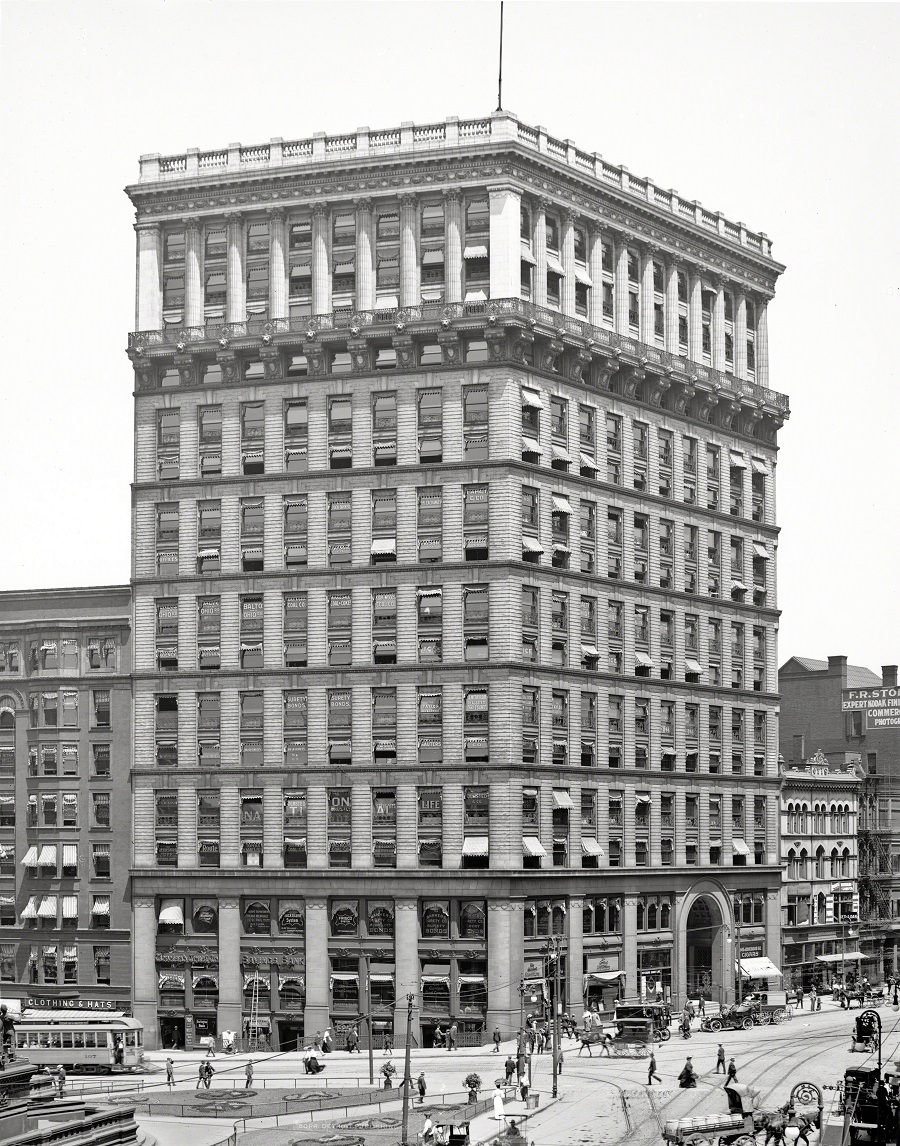
At the heart of downtown Cleveland, the Williamson Building (1905) asserts a formal presence with its banded stone façade, rhythmic rows of windows and a pronounced cornice that crowns the upper level. Pilasters and bracketed cornices give the massing a measured elegance, while the ground floor's arched storefronts and recessed entrances invite street-level commerce. Small details—striped awnings, painted window signs and decorative moldings—are rendered with crisp clarity, offering a textured view of early 20th-century commercial architecture. Along the busy intersection below, early streetcars glide along visible tracks as pedestrians, horse-drawn wagons and motor vehicles share the roadway, illustrating a city in technological transition. Storefront signage for clothing, hats and local services punctuates the street scene, and the steady flow of people emphasizes the building’s role as a hub of business and daily life. The mix of transportation modes and active sidewalks help tell the story of Cleveland’s urban rhythm in 1905. Seen from the corner, the photograph functions as a microcosm of urban growth and civic identity, where architectural ambition met bustling commerce. For historians, architects and local enthusiasts, the Williamson Building offers a rich study in façade composition, materiality and the visual language of turn-of-the-century downtowns. Return visits to the image reveal new layers of signage, activity and design, making it a valuable piece for anyone researching Cleveland’s built environment and social history.