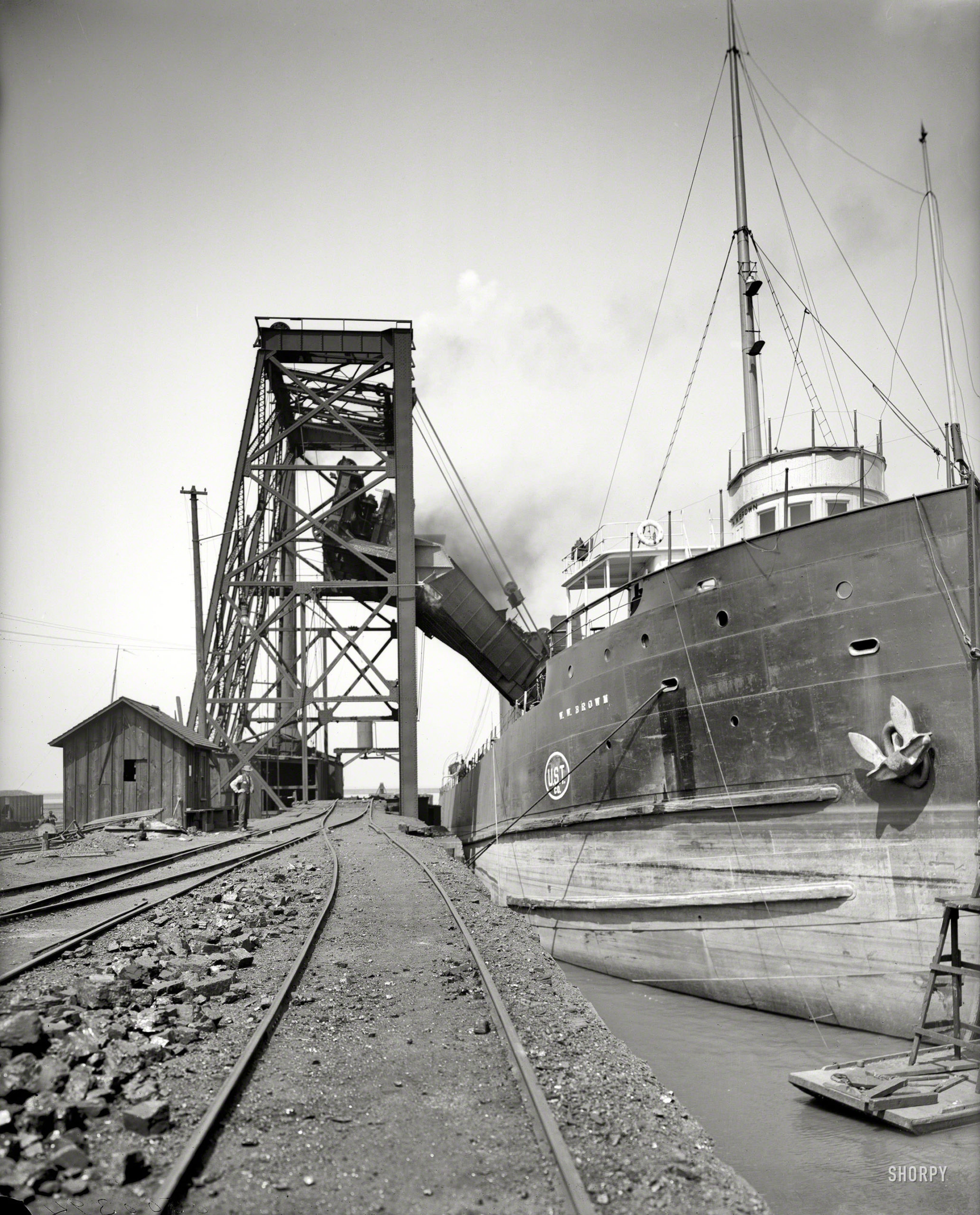
Along the Cleveland waterfront circa 1910, the freighter W.W. Brown lies close to a bulky coal trestle as a conveyor chute pours dark coal into her hold. The composition emphasizes the meeting of two transport worlds: narrow-gauge rails running along the quay, scattered stone ballast underfoot, and the great steel hull moored at the waterline. Small shore buildings and the ship’s rounded pilothouse punctuate the scene, giving a sense of scale to the industrial machinery and the tight choreography required to reload a working freighter. A towering gantry dominates the middle ground, its latticework framing workers and moving gear as steam and smoke blur the distant sky. The loading apparatus and the tethered lines from ship to shore hint at the labor-intensive processes of the era—railcars dumping coal into hoppers, men guiding chutes, and stokers counting on reliable bunkers to keep steam engines running. Close inspection of the hull and anchor details also reveals how design and function met the demands of Great Lakes freight traffic in the early twentieth century. Seen as a whole, the image is a vivid record of maritime and industrial history: coal as the lifeblood of city factories and steam propulsion, the interdependence of rail and lake commerce, and the crowded, noisy atmosphere of an active port. For anyone researching freighters, Cleveland’s maritime past, or early 1900s logistics, the W.W. Brown at the quay offers a concrete snapshot of the infrastructure and workmanship that kept cities and industries moving.