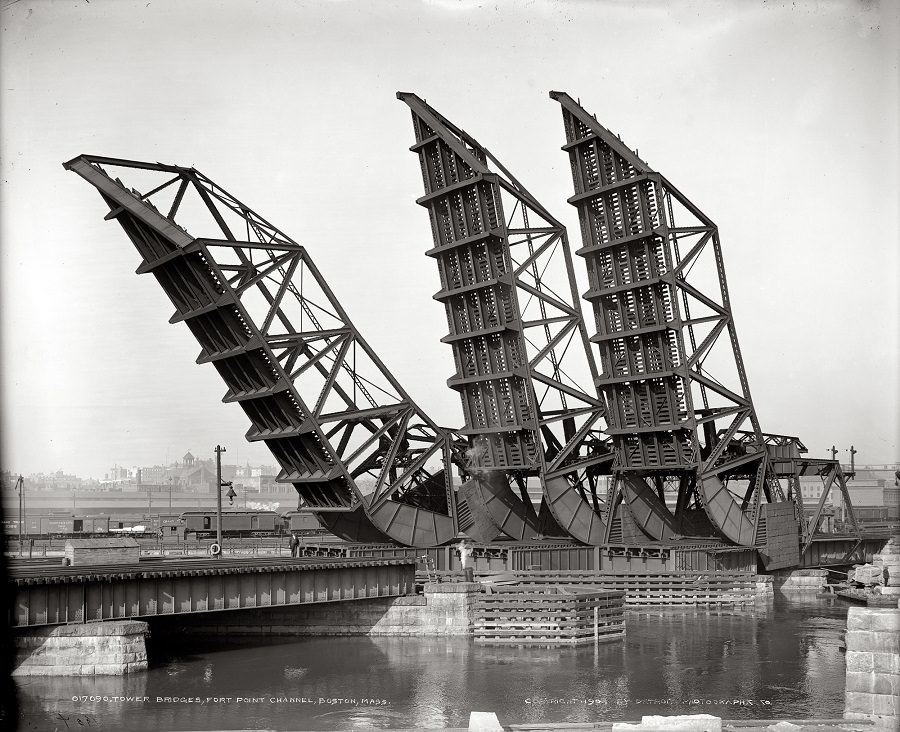
Rising like a pair of steel wings over Fort Point Channel, Boston’s Tower bridges are caught mid-lift, their riveted trusses and counterweights turning a utilitarian crossing into a moment of industrial drama. The open spans create a bold zigzag silhouette against a pale sky, emphasizing the engineering confidence that defined early twentieth-century infrastructure. Even without crowds in the foreground, the scene feels busy—built for motion, commerce, and the constant negotiation between land traffic and maritime passage.
Along the waterline, heavy stone piers and timberwork hint at the practical labor behind the spectacle, while the channel itself reads as a working corridor rather than a scenic backdrop. In the distance, low buildings and smokestack-era outlines soften into haze, suggesting a city expanding outward from its waterfront industries. The composition draws the eye from the calm surface of the channel up through latticed steel, making the bridges the unmistakable protagonists of this Boston harbor view.
For anyone searching for historic Boston photos, Fort Point Channel history, or early bridge engineering, this 1904 view offers a crisp window into a transitional cityscape. The mechanical elegance of the raised spans speaks to an era when rail, road, and shipping had to share tight urban space with minimal compromise. As “Places & People” implies, the human presence is mostly indirect here—embedded in the bolts, masonry, and design choices that kept Boston moving.