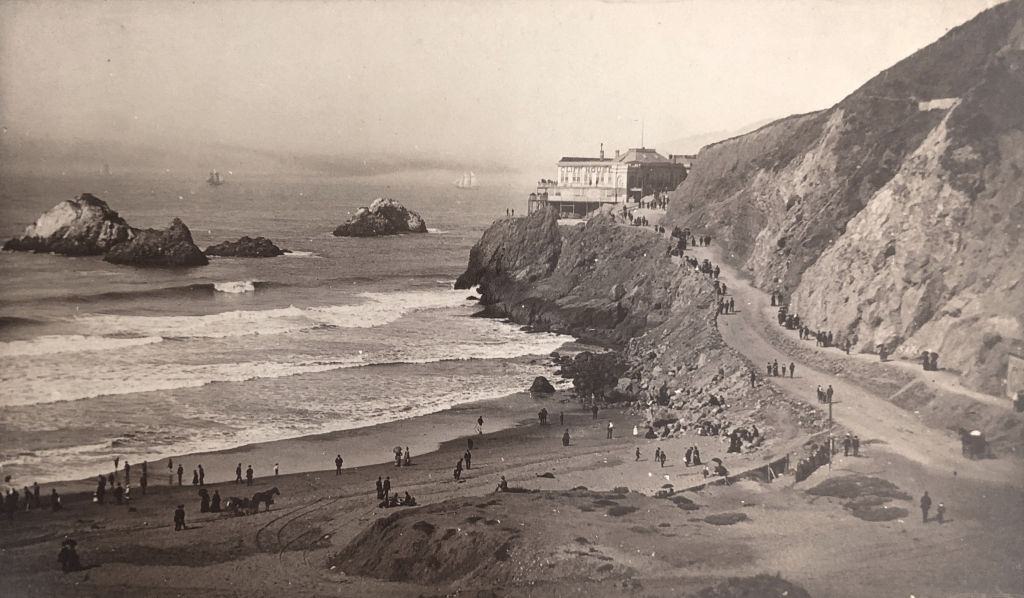
Perched on a rugged headland above the surf, the Cliff House appears as both destination and landmark—an inviting structure set against dramatic coastal cliffs. Below, the beach spreads wide and dark, dotted with small figures who give a sense of scale to the ocean’s sweep and the rocky outcrops offshore. Even at a distance, the scene carries the unmistakable pull of a Victorian-era seaside excursion.
Along the shoreline and the winding road, clusters of visitors linger, stroll, and gather in pairs or small groups, turning the coast into a public promenade. The camera’s elevated viewpoint lets the eye travel from the breakers to the bluff, following the path of people as they move toward the building that anchors the composition. Details like the layered waves, scattered rocks, and soft atmospheric haze evoke the mood of a day spent sightseeing where nature and leisure meet.
As a souvenir cabinet card from the 1890s, this photograph also speaks to how travel was remembered and shared—an affordable keepsake meant to be handled, shown, and saved. Cabinet cards often celebrated notable attractions, and the Cliff House fit the bill perfectly: scenic, recognizable, and tied to the era’s growing culture of tourism. For collectors of antique photographs and coastal history, it offers a vivid glimpse of places and people at the edge of land and sea.