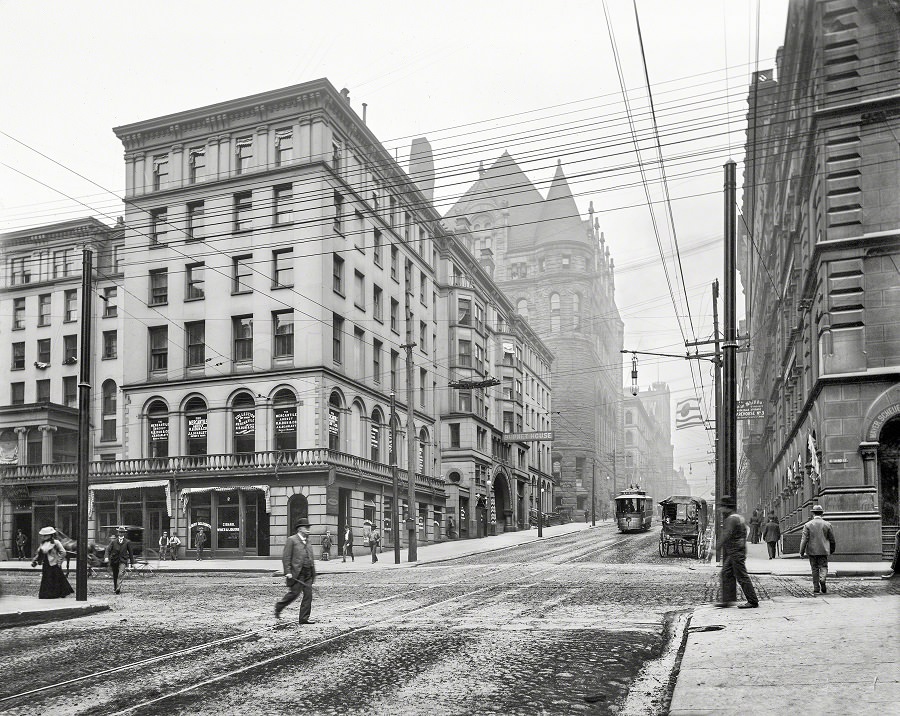
Streetcar wires lace the sky above a busy Cincinnati thoroughfare, where the Burnet House hotel rises in crisp tiers of windows and arched storefronts at street level. Painted signs in the lower windows hint at the commercial bustle inside, while pedestrians in hats and long coats step carefully across the broad, textured roadway. The composition draws the eye down the tracks, giving a sense of a downtown built for movement—on foot, by rail, and by carriage.
Midway down the street, the Chamber of Commerce building stands out with its heavier, more monumental silhouette, anchoring the scene behind the hotel’s straighter lines. A streetcar approaches through the haze, and nearby a horse-drawn vehicle waits along the curb, capturing a moment when older and newer forms of transit shared the same space. Even without close-ups, the period details—cobblestones, overhead lines, and dense masonry façades—place this view firmly in turn-of-the-century urban America.
Together, the Burnet House and the Cincinnati Chamber of Commerce represent two complementary faces of the city around 1900: hospitality for travelers and the organized energy of business and civic ambition. For anyone searching Cincinnati history, early downtown architecture, or the evolution of city streetscapes, this photograph offers a rich, grounded glimpse of everyday life framed by landmark buildings. It’s a reminder that the story of a city often survives in the practical details—where people walked, how they moved, and what rose above them in stone and brick.