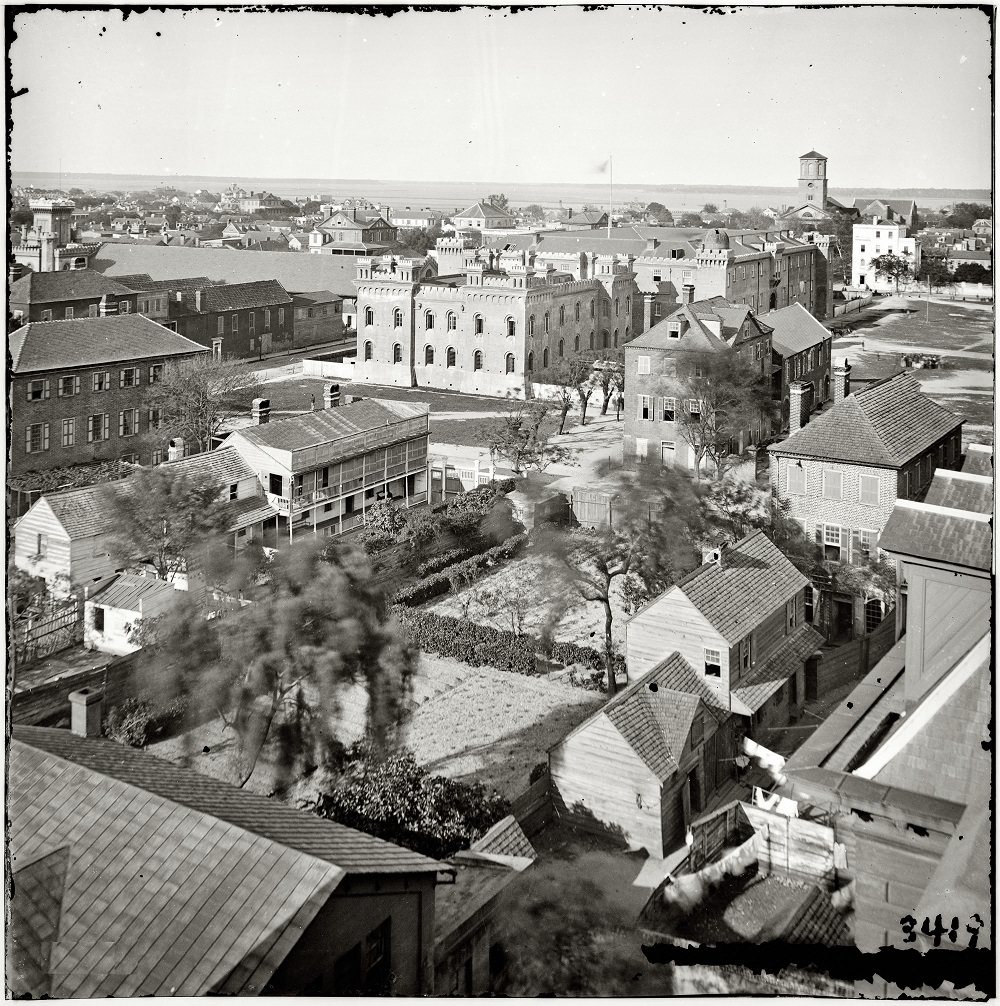
Perched above Charleston in 1865, the roof of the Orphan Asylum offered a sweeping, almost maplike view across a city of rooflines, courtyards, and narrow streets. Wooden outbuildings and fenced yards fill the foreground, while denser blocks of townhouses and institutional buildings rise behind them, their chimneys and gables stepping toward the distant horizon. The high vantage point turns everyday architecture into a layered panorama, letting you trace how neighborhoods knitted together in the mid-19th century.
At the center of the scene, a prominent complex with crenellated, castlelike detailing anchors the composition and hints at Charleston’s mix of civic ambition and distinctive local style. Nearby, a church tower punctuates the skyline, a familiar landmark shape that would have helped residents orient themselves long before modern street signage and skyscrapers. The open spaces, scattered trees, and visible garden plots suggest a city where domestic life, service buildings, and institutional grounds sat close together.
Taken in the immediate aftermath of the Civil War, this 1865 Charleston photograph carries a quiet documentary power, capturing the built environment at a moment of transition. For historians, genealogists, and architecture enthusiasts, details like roof materials, porch lines, window patterns, and street layout offer clues about construction practices and urban growth. Readers searching for “Charleston 1865,” “Orphan Asylum Charleston,” or “historic Charleston rooftops” will find in this view a vivid snapshot of places and people, even when the individuals themselves remain outside the frame.