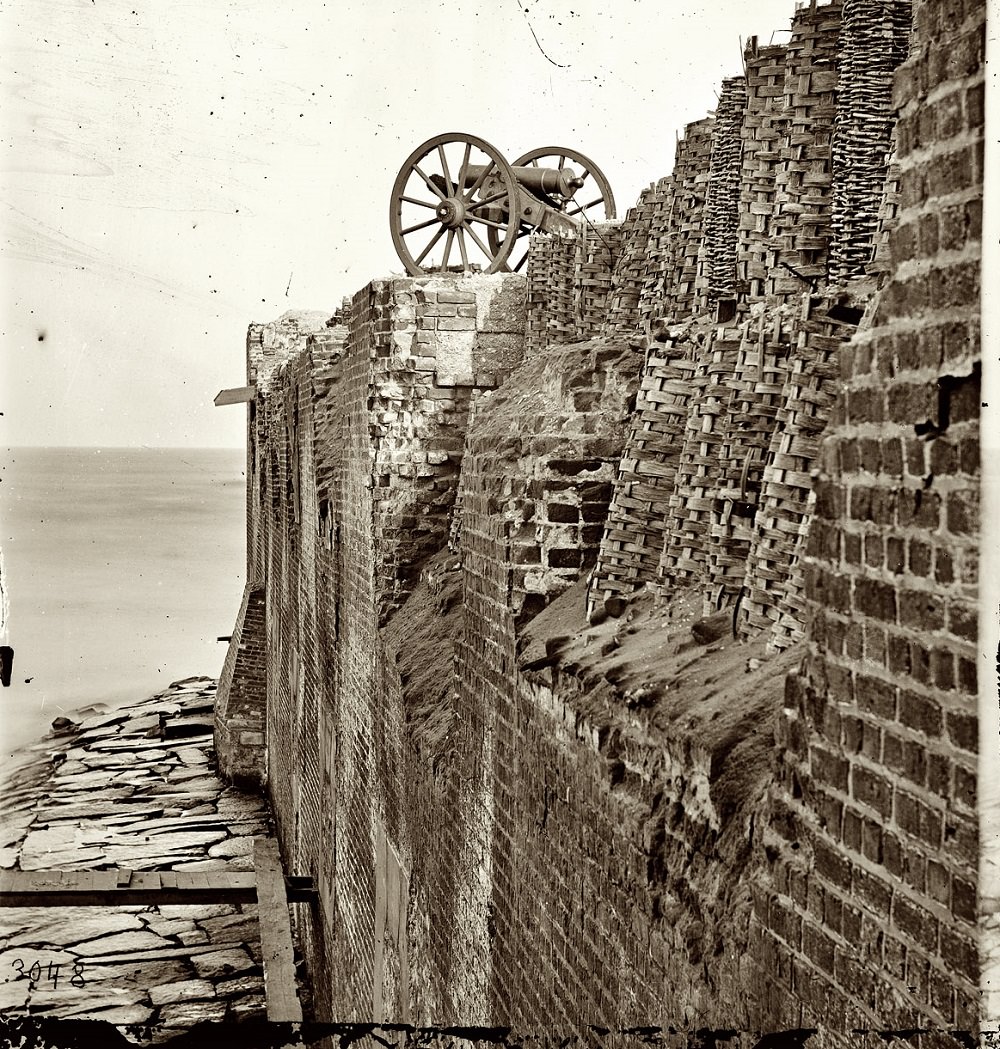
Along the north wall of Fort Sumter, the camera lingers on a hard-won patchwork of survival: brickwork sheared away, the rampart’s edge jagged, and a cannon perched above as if still keeping watch over Charleston Harbor. Woven gabions—basket-like revetments packed to blunt incoming fire—rise in rough tiers where the masonry has been breached, turning a wound in the fort’s face into a defensive bulwark. The open water beyond only sharpens the sense of exposure, with the fort’s damaged profile standing stark against the pale sky.
Gabions tell a story of improvised engineering, built fast from available materials and designed to absorb impact where solid brick could not. In the photograph, their textured weave contrasts with the regular courses of the wall, revealing both the violence that tore the structure apart and the practical work that followed. The slumped earth and uneven repairs hint at ongoing maintenance—less a triumphant restoration than a necessary measure to keep the position functional in the aftermath of bombardment.
For readers interested in Civil War photography, coastal fortifications, and the layered history of Fort Sumter in 1865, this scene offers a close look at how war reshaped iconic places down to the level of individual bricks. It’s a “Places & People” moment without faces: the human presence is implied in every stacked basket and placed stone, evidence of labor conducted under pressure and uncertainty. As a historical record, the image preserves not just damage, but the ingenuity of repair that helped define Charleston’s wartime landscape.