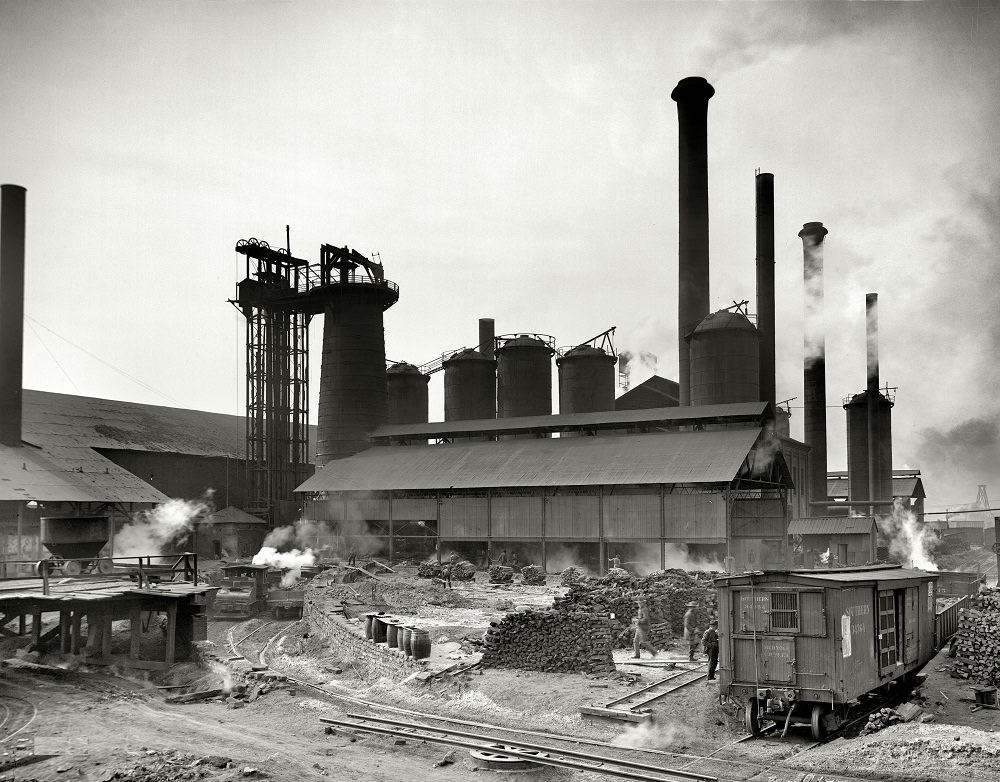
Rising above a rough web of tracks and slag, the Sloss City furnaces dominate the Birmingham skyline in 1906 with tall stacks and bulky industrial towers silhouetted against a hazy sky. Smoke and steam drift across the yard, softening hard edges while emphasizing the constant heat and motion of ironmaking. The long roofline of the works anchors the scene, a reminder of how large-scale manufacturing reshaped Alabama’s landscape at the start of the twentieth century.
In the foreground, a small rail car sits on narrow rails, hinting at the internal logistics that kept the plant running—hauling materials, moving byproducts, and feeding the furnaces’ appetite. Piles of dark residue and scattered equipment suggest the gritty, labor-intensive environment surrounding the blast operations. Even at a distance, the site reads like a complete industrial system: power, transport, and production packed tightly together.
Few photographs convey Birmingham’s “Steel City” identity as clearly as this view of Sloss City, where industry defined both place and people. For readers interested in American industrial history, Southern manufacturing, or the story of Sloss Furnaces, this image offers a textured look at the infrastructure behind everyday steel. It’s a striking historical snapshot of a working landscape—part machine, part city—built to run without pause.