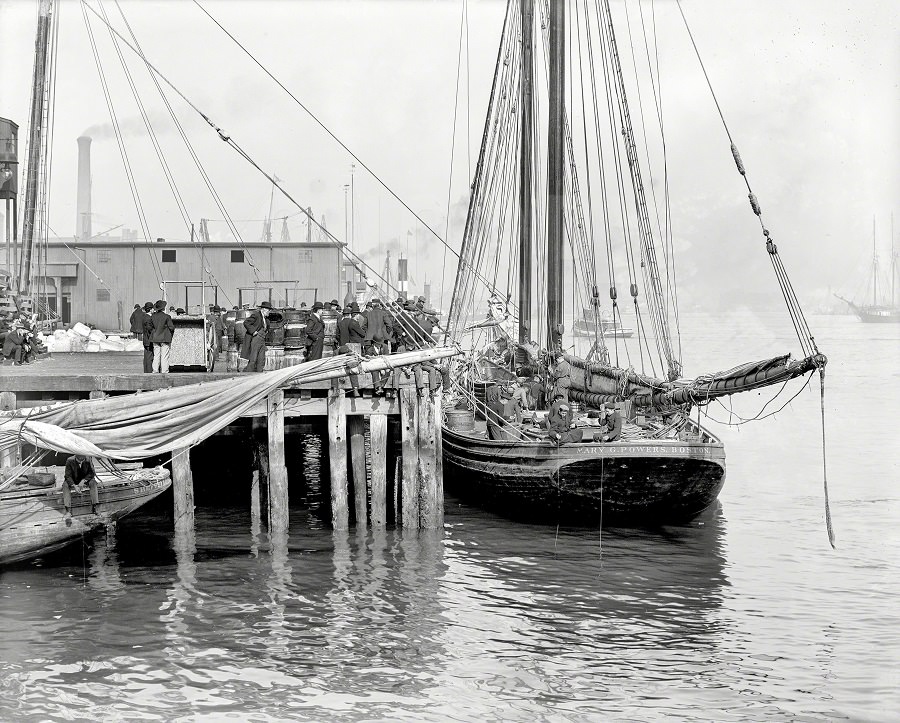
Morning haze hangs over Boston Harbor as a fishing schooner lies snug against the ‘T’ wharf, its tall mast and web of rigging cutting sharp lines into the pale sky. Along the pier, a dense knot of dockworkers and onlookers gathers near stacks of barrels and crates, suggesting the steady rhythm of unloading, sorting, and trading that once animated the waterfront. The water below reflects the pilings and hull in rippling silver, while distant smokestacks and faint ship silhouettes hint at a port city powered by both sail and industry.
On the schooner’s deck, figures cluster near the rail and around bundled gear, the scene crowded with practical details—coiled lines, booms, and heavy canvas—speaking to the labor that sustained New England’s fisheries. The vessel’s dark hull sits low and solid, built for work rather than ornament, and the wharf’s rough timbers show the wear of countless landings. Even without hearing the shouts or the slap of waves, the photograph conveys the busy choreography of a working harbor in 1903.
Boston’s ‘T’ wharf appears here not as a postcard view but as a lived place where people, cargo, and ships met at close quarters. Industrial buildings onshore stand alongside the traditional fishing fleet, capturing a moment when maritime trade and modern infrastructure overlapped in daily life. For readers interested in Boston history, harbor archaeology, or early twentieth-century maritime culture, this image offers a richly textured glimpse into the city’s waterfront economy and the community built around it.