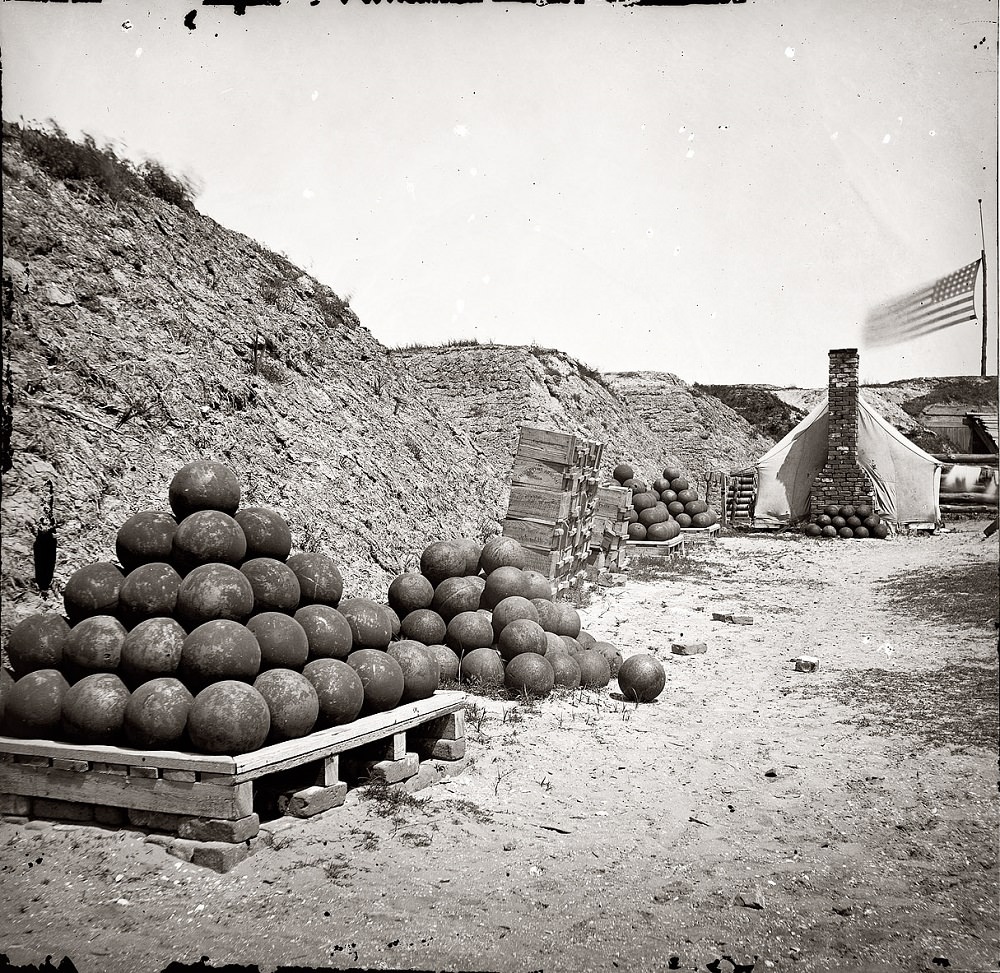
Along the sandy berms of Fort Johnson on Morris Island, the war’s material reality sits in heavy silence: pyramids of cannonballs stacked on wooden platforms and in loose clusters, ready for use or recently gathered after firing. Rough earthen walls rise to the left, their layered sand and soil suggesting hurried engineering and the constant maintenance required to keep a coastal fortification intact. A narrow, worn path leads the eye deeper into the position, emphasizing how much of Civil War combat depended on logistics as much as bravery.
Near the right edge, a tent with a brick chimney stands like an improvised home, practical against damp sea air and the bite of cooler nights. Beyond it, a large artillery piece is partly visible, hinting at the fort’s purpose without the drama of battle; instead, the scene reads as a working landscape where men lived beside munitions and machinery. Overhead, the U.S. flag catches the breeze, a reminder that by 1865 the balance of power around Charleston had shifted, even if the scars of conflict remained etched into the sand.
For readers interested in Civil War history in Charleston Harbor, this 1865 view offers a grounded look at Morris Island’s fortified coastline—less about spectacle, more about the everyday infrastructure that sustained prolonged operations. Details like the stacked shot, timber crates, and earthen revetments invite questions about supply lines, ammunition handling, and the constant labor of garrison life. It’s a compelling “places and people” record precisely because the people are off-camera, while their routines and risks are written all over the scene.