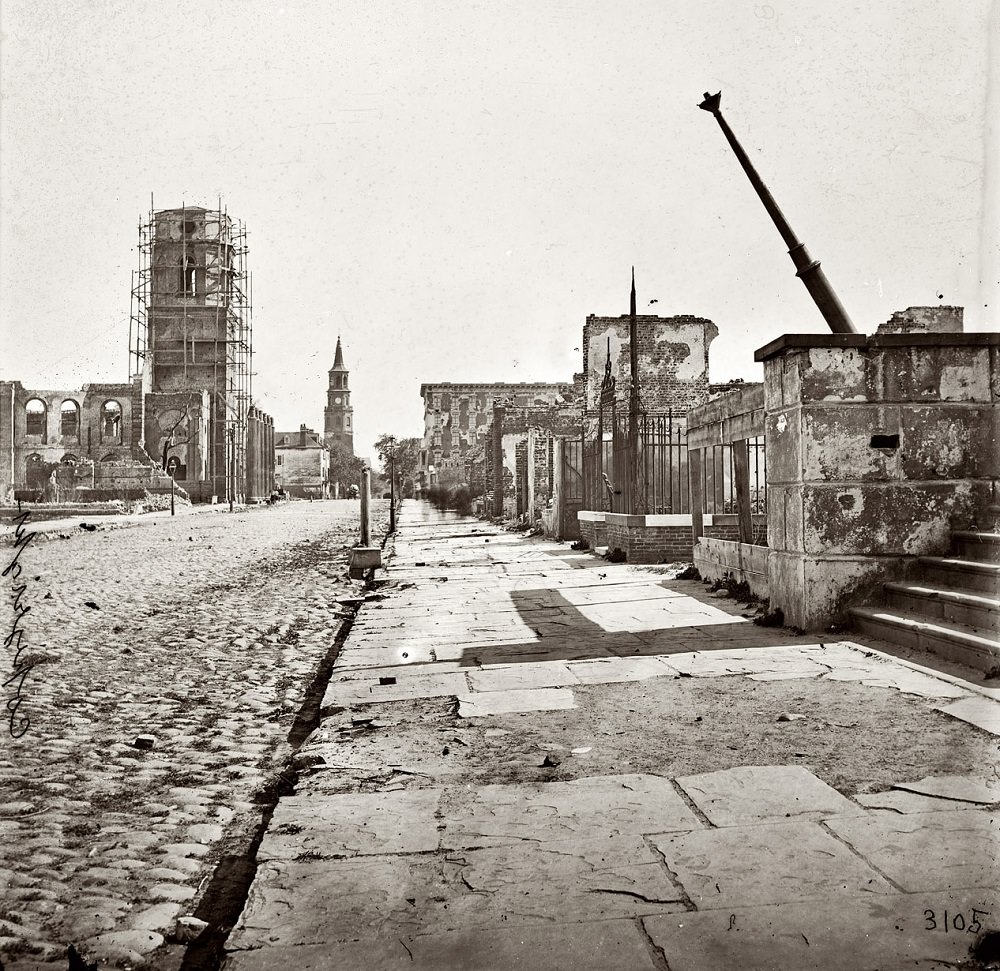
Meeting Street stretches away to the south in 1865, a long corridor of cobblestones and broad paving slabs leading the eye toward St. Michael’s Church rising in the distance. The street feels unusually quiet, with little to interrupt the perspective except scattered debris and the hard geometry of curbs and posts. For anyone searching Charleston history, this view offers an unmistakable sense of scale: everyday roadway in the foreground, landmark steeple anchoring the horizon.
On the left, the Circular Church appears as a shell—tall, exposed arches and a round tower wrapped in scaffolding, signaling repair or stabilization after damage. Across the scene, broken walls and jagged rooflines turn the streetscape into a study in loss as much as architecture, where brick and stone sit open to the sky. Even without crowds, the photo conveys a city in transition, documenting how familiar buildings endured, fractured, and began to be rebuilt.
Closer to the viewer, the Mills house and neighboring structures line the right side, their facades and ironwork framing the battered streetscape and guiding attention down the block. A leaning pole and worn masonry details add texture that modern photographs rarely capture, reminding us how the post-war landscape was both functional and scarred. As a historical image of Meeting Street, St. Michael’s Church, and the ruins of the Circular Church, this scene preserves a moment when Charleston’s past and its recovery were visible in the same frame.