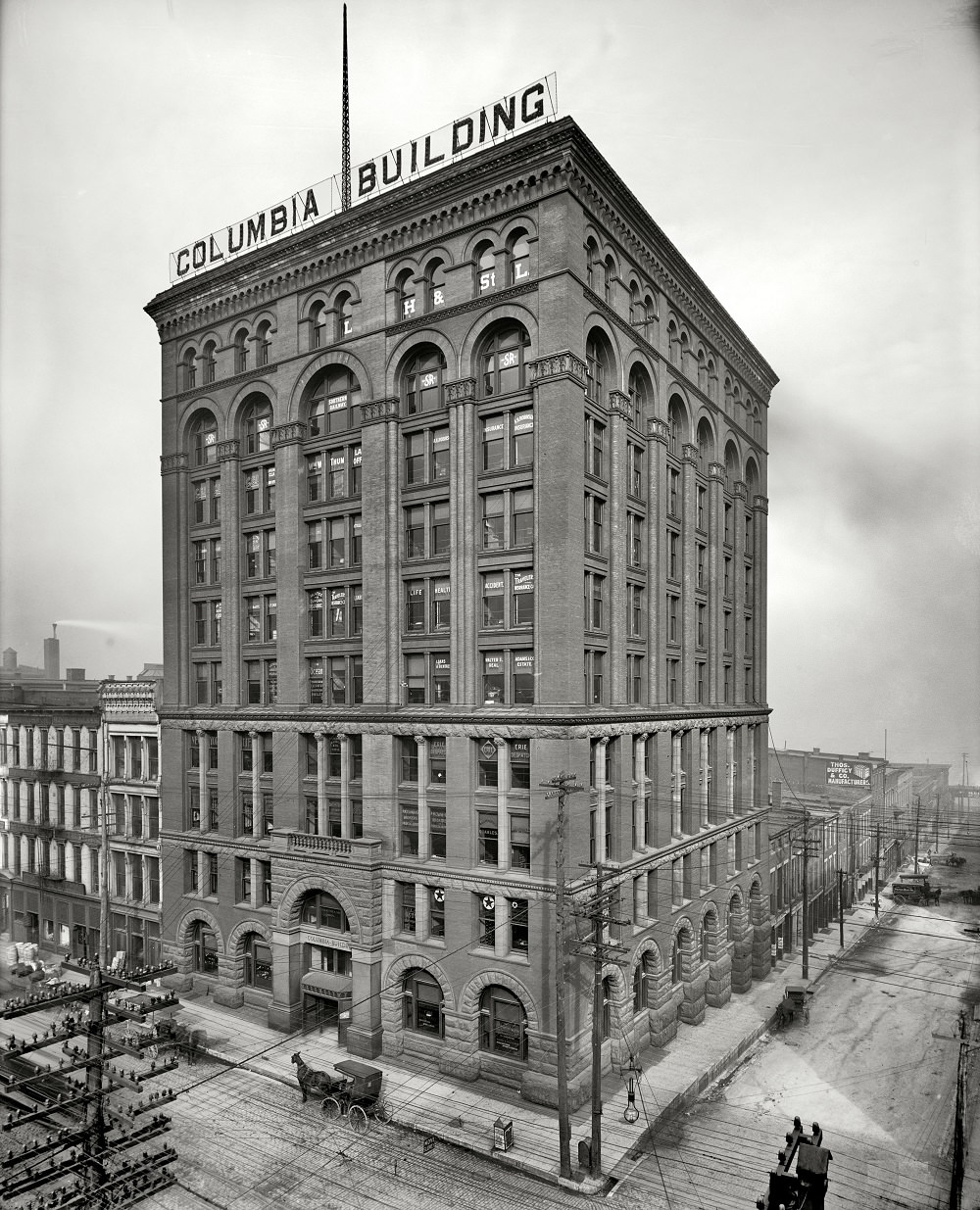
Rising above the intersection of Fourth and Main, the Columbia Building announces itself with bold rooftop lettering and a confident, blocky silhouette that speaks to Louisville’s early-20th-century ambitions. The structure’s heavy stone base, tall vertical bays, and repeating arched windows create a strong rhythm up the façade, while the upper stories feel almost palatial in their ornament and symmetry. From this elevated vantage, the building reads as both a commercial address and a landmark meant to be seen from blocks away.
Street-level details pull the scene into everyday life: a web of overhead wires, tracks scored into the roadway, and small figures gathered along the sidewalks hint at the constant movement of downtown. Large arched openings at the base suggest storefront or lobby entrances, designed to invite foot traffic before the eye climbs to the office floors above. Even without focusing on any single person, the photograph is full of “places & people” energy—architecture built for business, and streets built for crowds.
For anyone searching Louisville history, Fourth and Main, or the city’s classic commercial architecture, this 1906 view offers a crisp look at how the urban core was shaped by tall masonry buildings and dense infrastructure. The Columbia Building stands as a reminder of an era when signage on the roof served as a skyline signature and when the geometry of windows and cornices conveyed status as clearly as a name on the door. It’s a compelling snapshot of downtown Louisville’s scale, texture, and momentum at the start of a new century.