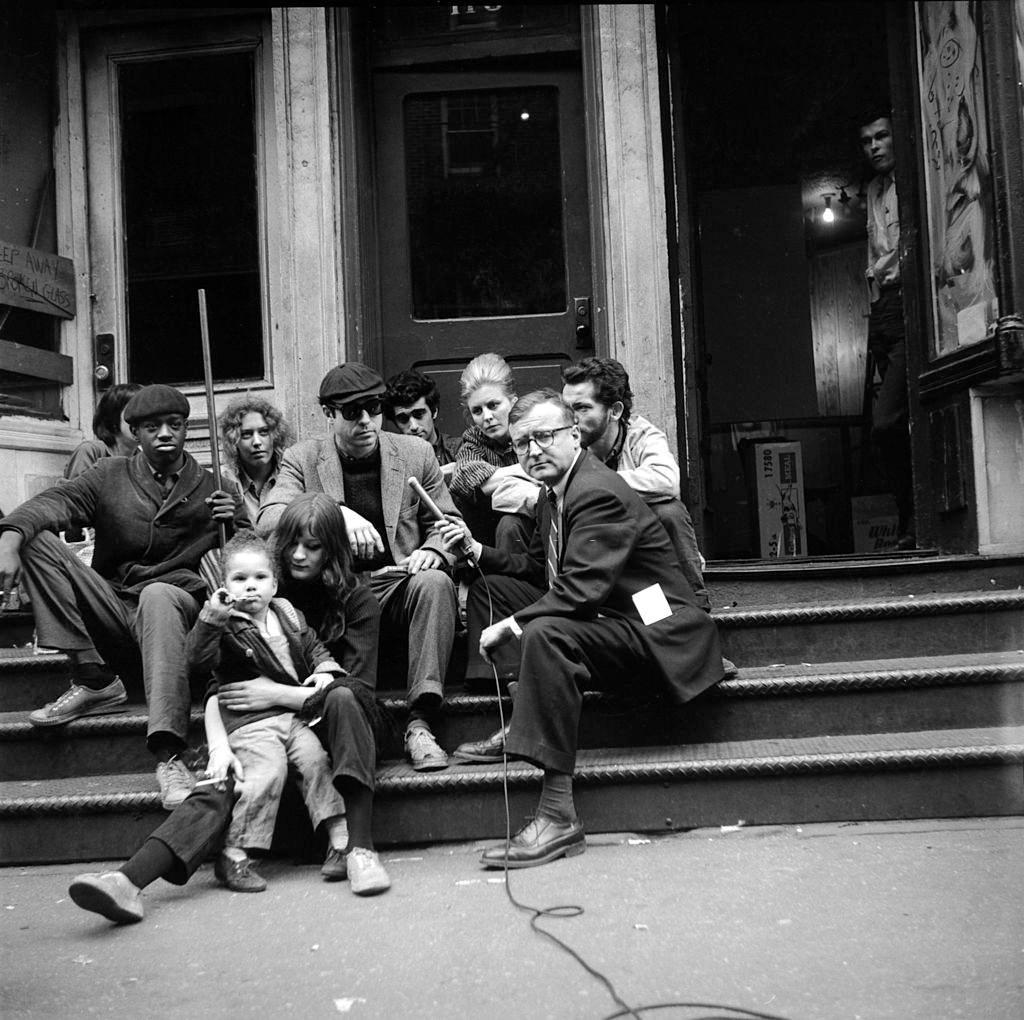
On the front steps of a worn New York storefront, television journalist Danny Meenan crouches in a suit and tie, microphone extended toward a small circle of Beatniks gathered at street level. The group looks relaxed but watchful—caps and dark glasses, tousled hair, cigarettes, and layered jackets—while a child sits in the foreground, turning the scene into something more intimate than a posed press photo. Behind them, an open doorway and scuffed wood trim hint at a lived-in block where conversations spilled out onto the stoop.
What makes the moment compelling is the meeting of two worlds: the tidy authority of early TV news and the deliberately unpolished style of the Beat generation. Meenan’s wired microphone trails across the sidewalk, a literal line connecting mainstream media to a countercultural cluster that preferred poetry readings, coffeehouses, and public dissent to polite society. Faces angle toward the reporter, some engaged, some wary, as if deciding how much of their private reality should be translated for a television audience.
As a slice of New York in 1960, the photograph doubles as a study in places and people—urban architecture, streetwear, and the choreography of an interview happening in public. It’s also a reminder of how quickly Beatnik culture became both a lived identity and a media story, framed through lenses like Meenan’s and broadcast to living rooms far from the city. For readers drawn to mid-century street photography, journalism history, or Beat-era New York, this image offers a grounded, human-scale view of a cultural shift in progress.