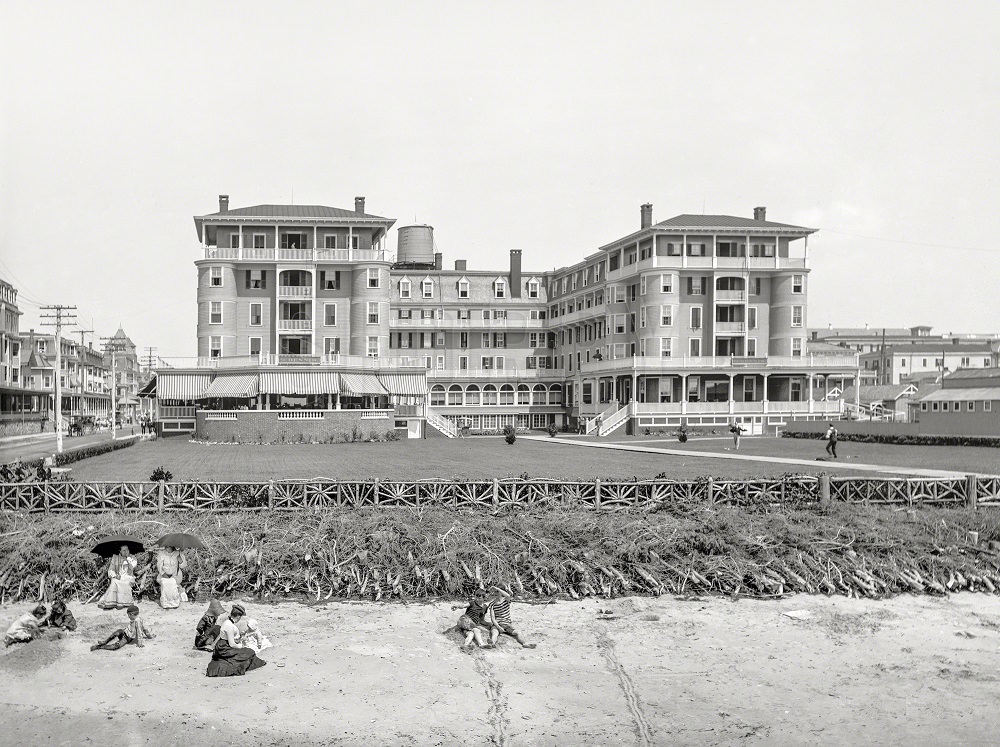
Rising behind a wide stretch of sand, The Dennis stands as an early-1900s Atlantic City landmark—an expansive seaside hotel with stacked verandas, corner towers, and a long, symmetrical façade built for ocean air and summer crowds. Architectural details like the wraparound porches and prominent roofline hint at a time when resort life centered on grand public spaces and a commanding view of the shore. Even from a distance, the building’s scale suggests the ambition of a growing beach destination at the turn of the century. Down on the beach, small groups linger close to the waterline: children sit in the sand while adults cluster under umbrellas, their clothing still formal by modern standards. The scene feels unhurried, capturing the everyday rhythms of a resort town—quiet leisure in the foreground, bustling hospitality in the background. A fenced edge and neatly kept grounds separate the hotel’s property from the beach, offering a subtle reminder of how carefully curated these oceanfront experiences could be. For anyone searching for “The Dennis, Atlantic City, 1901,” this photograph offers more than a building portrait; it’s a snapshot of places and people sharing the same shoreline. The contrast between the monumental hotel and the intimate beachside moments helps evoke what a vacation looked like in that era, from architecture designed for promenading to the social rituals of seaside relaxation. As a piece of Atlantic City history, it invites a closer look at how the city’s famed resort identity was built—one veranda, one umbrella, and one summer afternoon at a time.