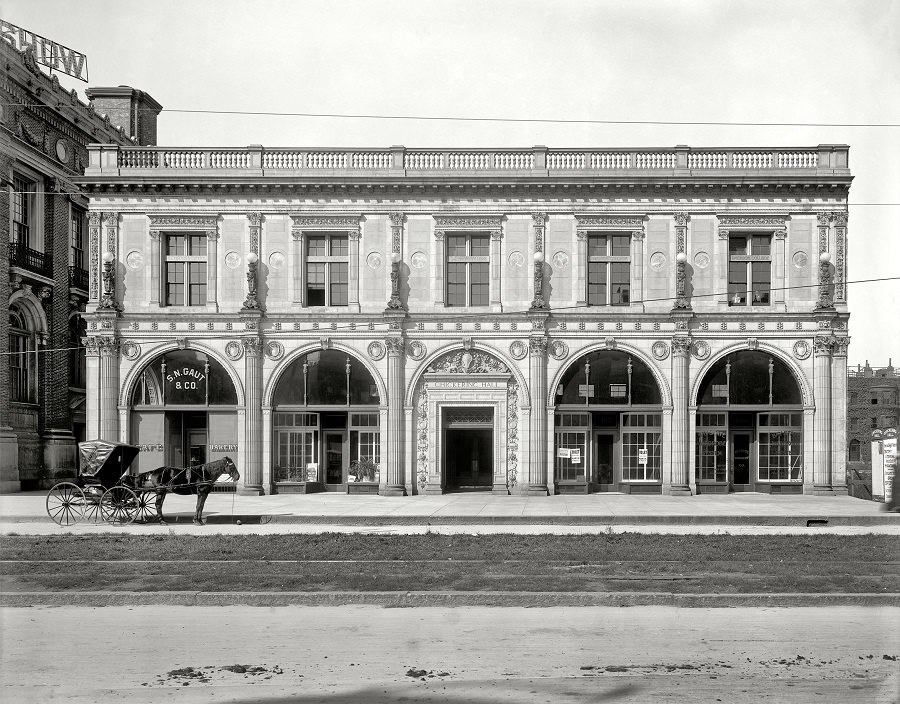
Along Tremont Street in Boston, Chickering Hall stands with a confident, classical façade—symmetrical windows above and a row of grand arches at street level that hint at busy entrances and storefront life. Decorative pilasters, carved panels, and a balustraded roofline give the building the kind of refinement expected of a prominent music and cultural venue in the early 1900s. Overhead wires cut across the scene, a quiet reminder of the city’s modernizing infrastructure in 1906.
Near the curb, a horse-drawn carriage waits, adding a human-scale detail that anchors the architecture in everyday movement and routine. The wide roadway and open foreground suggest a moment of calm between arrivals, when pedestrians and patrons might be just out of frame. In the archways and windows, signage is faint but present, reinforcing that this was not only an impressive hall but also part of a commercial streetscape.
For anyone exploring historic Boston photos, Tremont Street history, or the evolution of performance spaces, this view of Chickering Hall offers a crisp snapshot of the city’s built environment at the turn of the century. It’s an image that rewards lingering: the interplay of ornament and utility, the contrast between carriage era and wired streets, and the enduring emphasis on civic elegance. Even without crowds, the building seems to hold the echo of concerts, gatherings, and the daily rhythm of downtown Boston.