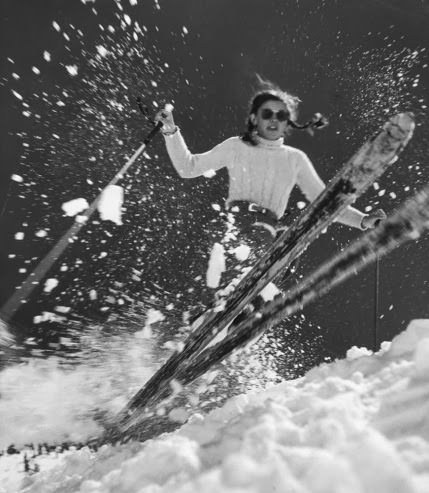
Carving toward the camera with snow exploding into the air, fifteen-year-old Andrea Mead Lawrence looks every bit the fearless competitor she would soon become. The low angle emphasizes the speed and steepness of the run, while her dark goggles, steady stance, and outstretched pole suggest a teenager already practicing with a professional’s focus. It’s an arresting glimpse of alpine skiing training in 1947, when technique and nerve mattered as much as modern equipment.
What stands out is the physicality of the moment: long skis slicing through a churned-up ridge, a tight grip on the pole, and a posture that balances control with aggression. The scene hints at the era’s gear and conditions—minimalistic by today’s standards—yet the fundamentals of slalom-style movement and edge control are unmistakable. For readers interested in Olympic history, women’s sports, and the evolution of ski racing, the photo offers a vivid, kinetic reference point.
Years later, Lawrence would be remembered as the first American alpine skier to win Olympic gold, and the title frames this image as an early chapter in that journey. Rather than a posed portrait, it delivers the unfiltered drama of training: repetition, risk, and the relentless pursuit of faster lines. In a single frozen instant, the spray of powder becomes a kind of foreshadowing—proof that greatness often begins long before the medals.