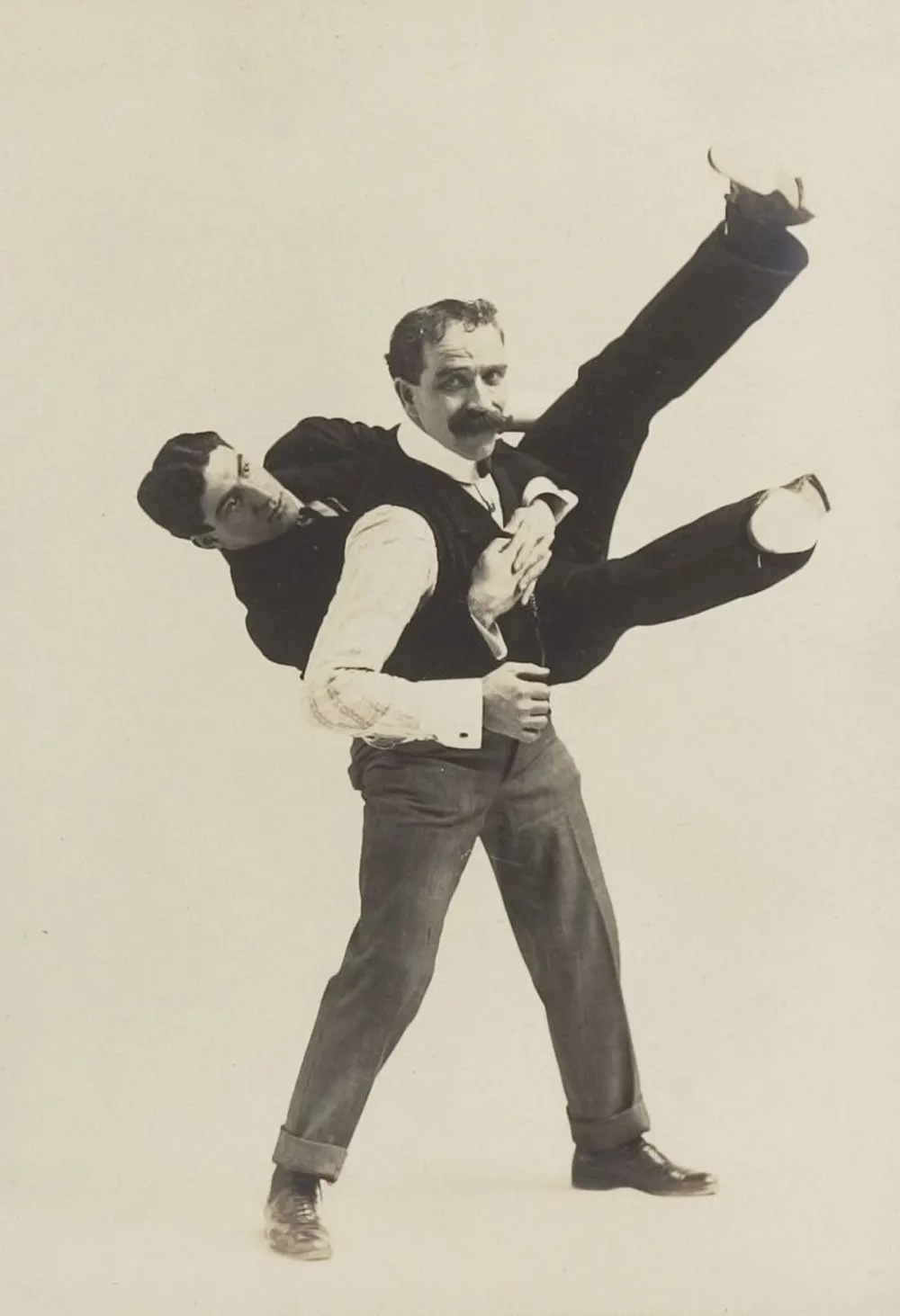
A sharply staged maneuver freezes mid-motion: one man braces his stance while hoisting his opponent across the shoulders, legs flung outward in a dramatic arc. The crisp studio backdrop and formal Victorian attire—high collar, waistcoat, and neatly tailored trousers—turn what could be a chaotic scuffle into something methodical, almost instructional. As an illustration from a self-defense guide, the pose reads like a lesson in leverage and balance rather than brute force.
Published in 1895, this “sports” perspective on personal protection reflects an era when physical culture, boxing, wrestling, and practical drills were increasingly marketed to the public. The image suggests a controlled throw or lift meant to neutralize an attacker quickly, with the defender’s grip anchored at the torso and the lifted body kept off the ground. Details like polished shoes and composed expressions underscore how Victorian self-defense was presented as disciplined training—respectable, teachable, and modern.
Collectors and historians alike will appreciate how this historic self-defense guide bridges everyday anxieties and the period’s fascination with technique. It’s a revealing glimpse into Victorian-era martial instruction, where photographic demonstration helped translate complex maneuvers into steps a reader could imitate. For anyone exploring antique sports ephemera, early combat sports, or the history of self-defense, this 1895 image offers both visual drama and cultural context.