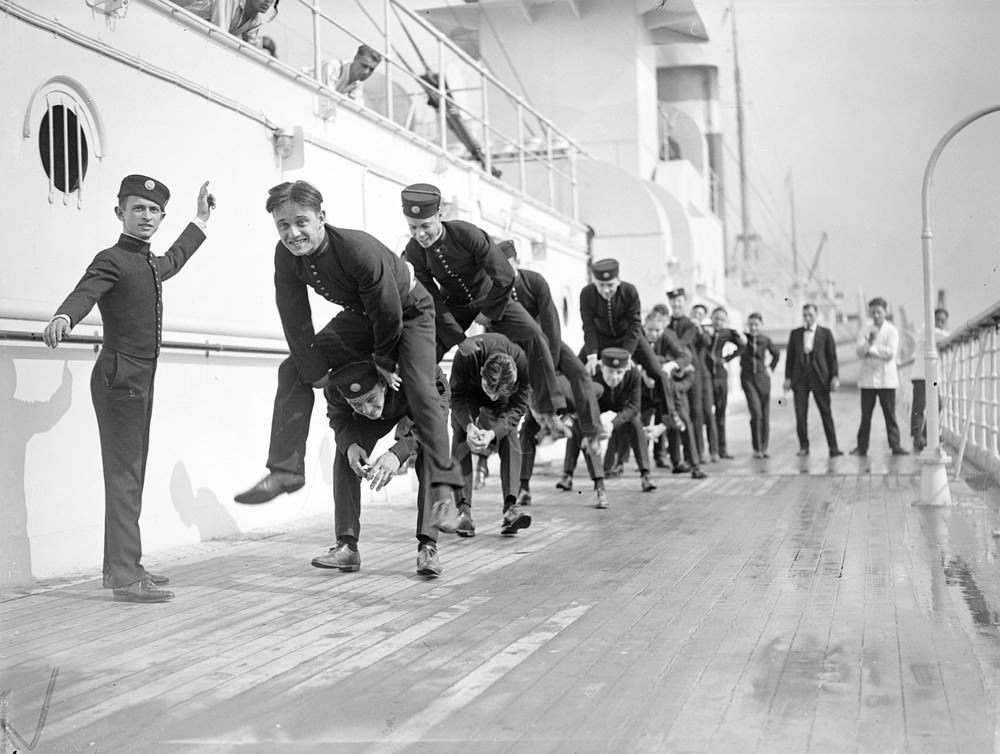
Along the broad planked sun deck of the US liner Leviathan, a line of young bellhops turns a formal uniform into a playground outfit, mid-leap in an impromptu game of leapfrog. Their caps and buttoned jackets read as shipboard discipline, yet the grins and bent backs give the scene a quick, human spark. The long perspective of railings, portholes, and towering superstructure frames the moment as both candid and carefully observed.
On arrival at Southampton in 1923, the ship’s working life and its public face met in the same stretch of open deck, where crew, passengers, and onlookers could all share the sea air. Leviathan’s layered identity—formerly the Hamburg America Line’s Vaterland—adds a quiet undertone to the laughter, hinting at how ocean liners changed flags and meanings in the early 20th century. Even without naming individuals, the photograph preserves the everyday culture of service at sea: youthful camaraderie, brief breaks, and the performance of good spirits aboard a famous liner.
Few historical images make the maritime world feel this immediate, balancing the scale of a transatlantic vessel with the small rituals that kept morale afloat. The scene is a crisp snapshot of shipboard leisure and early 1920s social history, perfect for readers interested in vintage sports, ocean liner life, and the working crew behind glamorous crossings. As a piece of Leviathan history at Southampton, it reminds us that the age of steam was built not only on engineering, but on people finding play wherever a deck offered room to run.