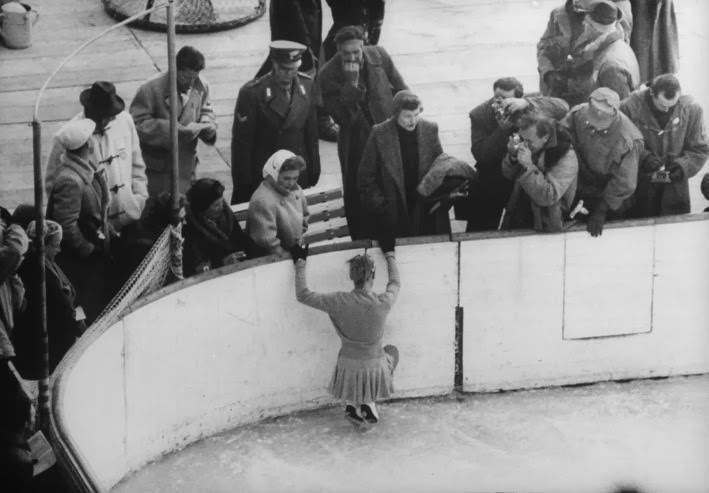
At rinkside in Cortina, Italy, the young American skater Carol Heiss pauses at the boards, arms lifted as she acknowledges the cluster of bundled spectators leaning in from above. Heavy coats, hats, and scarves frame the moment, while cameras and attentive faces suggest the press-and-fans crush that follows an Olympic performance. The scene feels intimate despite the crowd, capturing the brief exchange between athlete and audience before the arena moves on.
The composition draws the eye to the contrast between the smooth ice and the scuffed barrier, a reminder of how close figure skating can be to its viewers in older venues. Heiss’s skirt and skates mark her as the only figure on the ice in this slice of time, while officials and onlookers hover just beyond reach, peering over the rail. It’s a candid look at mid-century winter sports culture—part celebration, part scrutiny, all wrapped in cold-weather practicality.
As a companion to the post title, the photograph underscores why 1956 remains a landmark in Olympic figure skating history and why Heiss’s silver medal still resonates with fans of the sport. The image reads less like a posed victory shot and more like an in-between moment: gratitude, exhaustion, and adrenaline gathered at the edge of the rink. For readers searching for Carol Heiss, Cortina 1956, or classic Olympics photography, this frame offers a vivid, human-scale glimpse of competition’s aftermath.