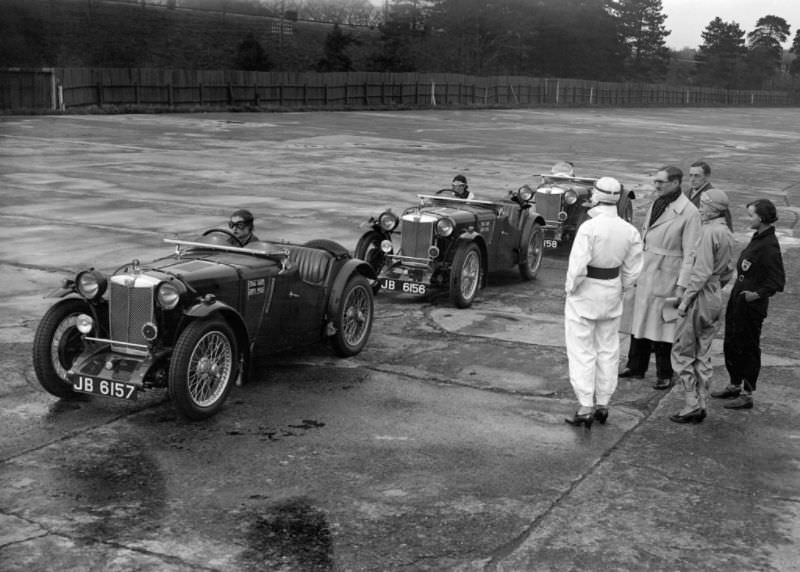
Three low-slung MG racing cars sit in a neat line on a wide stretch of track, their wire wheels and upright grilles giving the scene an unmistakably 1930s feel. Drivers remain at the wheels while a small group in coats and overalls gathers nearby, suggesting pre-race briefing, inspection, or a final check before running. The open expanse of tarmac and distant fencing emphasize the purposeful, almost ceremonial calm that often precedes endurance competition.
Known as the “Dancing Daughters,” these three MGs were entered for Le Mans by land speed record breaker George Eyston, borrowing a nickname from a popular variety act of the time. The teams paired in each car underline how endurance racing relied on coordination as much as courage: Car 54 was driven by Margaret Allen and Coleen Eaton, Car 55 by Doreen Evans and Barbara Skinner, and Car 56 by Joan Richmond and “Miss Jo.” In an era when motorsport headlines were dominated by men, the Brooklands Automobile Racing Club’s female drivers brought visibility and legitimacy to women’s competitive racing.
Beyond the personalities, the photo offers a textured glimpse into interwar motorsport culture—modest machinery pushed to its limits, practical clothing over glamour, and serious preparation over spectacle. The cars’ registration plates and competition numbers anchor the image in the working realities of racing logistics, not just legend. For readers interested in women in racing history, MG at Le Mans, or Brooklands-era British motorsport, this moment captures determination poised on the starting line.