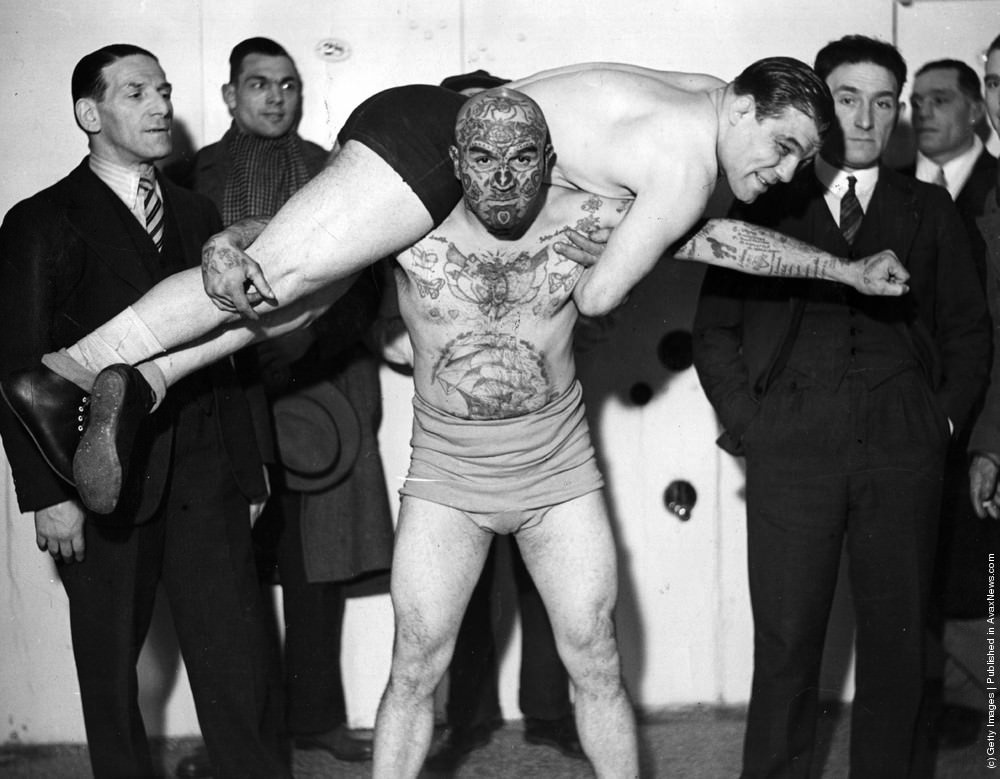
Jacobus Van Dyn—billed as the “Tattoo Man”—stands squarely at center stage, his torso and face densely inked and impossible to ignore. In a compact indoor setting, he hoists another man across his shoulders in a classic wrestling carry, turning spectacle into strength training while onlookers in suits lean in to watch. The contrast between bare-knuckle athletic display and the crowd’s formal dress gives the scene a charged, almost theatrical air.
Across Van Dyn’s skin, the tattoos read like a living poster: bold motifs on chest, arms, and face that would have helped sell a persona long before modern branding. The wrestler draped over him braces with a clenched fist, legs extended and taped at the ankles, as if the hold is being tested for balance and control rather than used to finish a bout. Faces in the background—curious, skeptical, entertained—underscore how wrestling in the 1930s often lived at the crossroads of sport and showmanship.
For readers drawn to vintage wrestling history, circus and sideshow culture, or the early popular fascination with tattooed performers, this photograph offers a vivid snapshot of the era’s entertainment economy. It suggests a moment of rehearsal or promotion: technique on display, bodies positioned for maximum impact, and a distinctive character at the center of the frame. The result is a memorable piece of 1930s sports imagery where identity, performance, and physical prowess meet in a single pose.