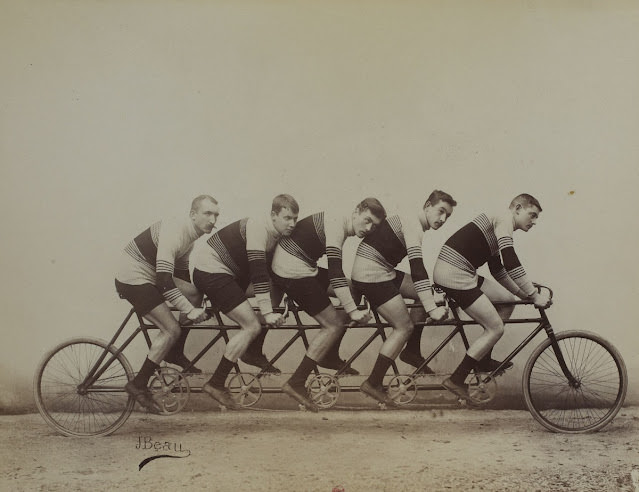
Six riders lean forward in matching striped jerseys, lined up like a single machine on an elongated tandem bicycle, their hands and shoulders repeating in a disciplined rhythm. The bare backdrop and level ground turn all attention to the contraption itself—thin wheels, a long frame, and a chain-and-crank system that had to translate six different cadences into one steady surge. It’s an arresting glimpse of tandem cycling sport at a moment when the bicycle was still new enough to feel experimental, yet already serious enough to demand uniform kit and practiced form.
Jules Beau’s sports photography often carries this blend of precision and theatre, and here the composition reads like an early study in speed and teamwork. Each cyclist’s posture mirrors the next, suggesting training, coordination, and the physical trust required when stopping, starting, and sprinting as a unit. Rather than isolating a lone champion, the photograph celebrates collective power—an approach that adds texture to the history of cycling beyond the familiar single-rider race narrative.
In the broader story of 19th century cycling, images like this help explain how the sport evolved alongside technology, from daring prototypes to organized competition. The long multi-seat tandem hints at the era’s fascination with engineering solutions for going faster and going farther, while the riders’ focused expressions underscore the athletic ambition behind the novelty. For anyone exploring antique sports photos, early bicycle racing, or the origins of tandem cycling, this Jules Beau scene offers a vivid window into the spectacle and discipline of the period.